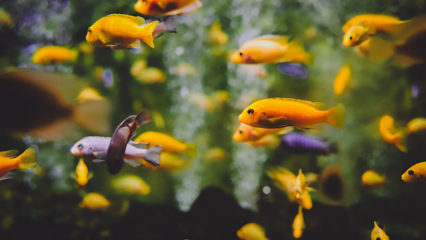
When students and teachers work together to study, produce and market aquatic products, there are endless opportunities for career exploration and hands-on learning in the areas of biology, math, chemistry, technology, marketing and business management.
The Aquaculture Educator Resources page is a tool to help you get started with and gather support for a school aquaculture project. Below you will find information, ideas, tips, contacts and resources for enhancing or developing aquaculture education in your classroom.
Benefits of Aquaculture Education
Aquaculture education:
- Provides students with a sense of ownership and responsibility.
- Helps students gain technical and hands-on skills.
- Offers opportunities for field trips and lab work.
- Offers opportunities for community involvement.
- Reinforces science, math, business and marketing skills.
- Offers students the opportunity to do science rather than learn science.
Fulfills many Sunshine State Education Standards.
Tips for Starting a School Aquaculture Program
[
 1.3 MB
]
provides educators with a step-by-step guide on important factors to consider before incorporating aquaculture or aquaponics on their campus. To learn the similarities and differences between these system types when determining which may be better suited for your campus, review
Aquaculture and Aquaponics: Which Is Right for You?
[
941.5 kB
]
Once you have determined the details of your system, use
Navigating the “Aquaculture System Checklist” for Educators
[
1.1 MB
]
to outline important system parameters and maintenance procedures. For information regarding saltwater systems, please email Aquaculture_Education@FDACS.gov.
1.3 MB
]
provides educators with a step-by-step guide on important factors to consider before incorporating aquaculture or aquaponics on their campus. To learn the similarities and differences between these system types when determining which may be better suited for your campus, review
Aquaculture and Aquaponics: Which Is Right for You?
[
941.5 kB
]
Once you have determined the details of your system, use
Navigating the “Aquaculture System Checklist” for Educators
[
1.1 MB
]
to outline important system parameters and maintenance procedures. For information regarding saltwater systems, please email Aquaculture_Education@FDACS.gov.
Aquaculture Certificate of Registration
Schools operating aquaculture systems for education do not need any permits unless the animals or plants produced from the system are sold for profit or unless a restricted species (e.g., tilapia) is possessed.
If you have a restricted species or plan to sell products from the education system, you will need an Aquaculture Certificate of Registration; however, this permit is available annually at no cost to educators.
If your school has an aquaculture system and is looking to start an aquaculture program, obtaining an Aquaculture Certificate of Registration may be the best next step. An Aquaculture Certificate of Registration is only required for schools selling aquaculture products or possessing restricted species. The certificate identifies your products as agriculture commodities and entitles you to the same benefits bestowed on other agricultural producers. The annual Aquaculture Certificate of Registration fee is waived for each elementary, middle, high or vocational school that participates in the aquaculture certification program pursuant to 597.004(1)(h), Florida Statutes.
For more information, please review
Benefits of an Aquaculture Certificate of Registration for Educators
[
648.4 kB
]
.
Helpful Contacts
- Aquaculture in Action: A national aquaculture education network that offers a wide range of teacher resources.
- The Florida Department of Agriculture and Consumer Services' (FDACS) Division of Food, Nutrition and Wellness: Provides educational resources for agriculture teachers.
- Florida Aquaculture Association (FAA): Offers on-site farm tours, assistance with the Future Farmers of America annual aquaculture competition, and an aquaculture industry certification. Contact info@flaa.org for more information.
- The International SeaKeepers Society unites scientific, academic and educational communities by offering lesson plans, beach cleanups and "floating classroom" opportunities to Florida educators and their students.
FDACS Introductory Aquaculture Presentations
The following PowerPoint presentations will help teachers introduce sixth- through 12th-graders to aquaculture as part of a standard agriculture or science course:
-
Aquaculture in the Classroom
[
 26.5 MB
]
26.5 MB
]
-
Introduction to Aquaculture
[
27.7 MB
]
-
Careers in Aquaculture
[
5 MB
]
-
Florida Aquaculture: Food Fish
[
23.2 MB
]
-
Florida Aquaculture: Ornamental Fish
[
12.9 MB
]
-
Florida Aquaculture: Reptiles
[
3.9 MB
]
-
Florida Aquaculture: Shellfish
[
17.6 MB
]
School Talks and Presentations Available
If you are interested in having FDACS's Division of Aquaculture give a talk or presentation for your school or classroom, email Aquaculture_Education@FDACS.gov to schedule a virtual or in-person talk. Both virtual and in-person sessions are subject to availability and the travel capacity of FDACS educators.
Topics for classroom talks or presentations include:
- Introduction to Aquaculture in Florida and Around the World
- The History of Florida Aquaculture
- Why is Aquaculture Important?
- Careers in Aquaculture
- Florida Aquaculture: Aquatic Reptiles and Amphibians
- Florida Aquaculture: Food Fish
- Florida Aquaculture: Marine Shellfish
- Florida Aquaculture: Marine and Freshwater Ornamentals
Topics for teacher/educator training include:
- Aquaculture in the Classroom
- Introduction to Aquaculture in Florida and Around the World — For Educators
Other Helpful Resources
Here’s a handful of additional resources we’ve found to help you teach about aquaculture. This list will be updated as we learn of new resources, so please check back periodically.
If you have or know of additional aquaculture education resources that you think should be included on our resource list, please email Aquaculture_Education@FDACS.gov.
-
2025 Florida Aquaculture Industry Overview
[
476 kB
]
- ACTED (Florida Atlantic University, Harbor Branch)
- Agricultural Literacy Curriculum Matrix (National Agriculture in the Classroom)
- Algal Cultivation Extension Short Courses: Macroalgae/Microalgae (Algae Technology Education Consortium)
- A.Q.U.A. Curriculum (Center for Tropical and Subtropical Aquaculture)
-
Aquaculture and Aquaponics: Which Is Best for You?
[
941.5 kB
]
-
Aquaculture at a Glance
[
486.3 kB
]
-
Aquaculture Educator Resources: Monthly Chore Chart
[
 102.7 kB
]
102.7 kB
]
- Aquaculture Toolkit (PIE Center)
- Aquaponics Food Production Systems (Open Access Book) (Springer Link)
- Aquaponics Production Manual [ Adobe PDF Document ] (Kentucky State University)
-
Benefits of an Aquaculture Certificate of Registration for Educators
[
648.4 kB
]
- Building a Tabletop Aquaponics System as a Platform for STEM Education [ Adobe PDF Document ]
- Education & Outreach (Florida Farm Bureau)
-
Florida Aquaculture Commodity Poster
[
3.6 MB
]
-
How to Save Your Fish During a Power Outage
[
985.3 kB
]
(University of Florida IFAS Extension)
- The Future of Ocean Farming (Ocean Today, NOAA)
- Indian River Research and Education Center Aquaculture Research and Demonstration Facility (University of Florida)
- Introduction to Aquaponics course (Alabama Cooperative Extension System)
- Marine and Coastal Science and More (Maryland SeaGrant Lesson Plans)
- Marine Fisheries & Aquaculture (PBS)
-
Navigating the Aquaculture Systems Checklist
[
1.1 MB
]
- Project PORTS, Oyster Curriculum (Rutgers University)
- SRAC: Publications Page (Southern Regional Aquaculture Center, USDA National Institute of Food and Agriculture)
-
Tips for Starting a School Aquaculture Program
[
1.3 MB
]
- Tropical Aquaculture Laboratory (UF/IFAS)
- Virtual Fish Farm (Virginia 4-H)
- Water Matters (Southwest Florida Water Management District)
UF/IFAS Introduction to Florida Aquaculture Commodities
The University of Florida Institute of Food and Agricultural Sciences (UF/IFAS) Shellfish Aquaculture Extension program produced a series of presentations for the Cedar Key High School S.A.L.T. (Shark Aquaculture Life Training) Program during the summer of 2018. The presentations provide an overview of the different aquaculture commodities in Florida. Visit UF/IFAS's Online Resource Guide for Florida Shellfish Aquaculture to access this free educational series.
Program topics include:
- Recirculating Systems
- Molluscan Shellfish Aquaculture
- Aquatic Plant Culture
- Shellfish Aquaculture Regulations and Leasing Process
- Food Fish Culture
- Ornamental Culture
- Alligator and Reptile Culture
Funding Sources for School Aquaculture Projects
Aquaculture projects may be funded by existing program budgets in the school system (including vocational and extracurricular), school fundraisers, donations, aquaculture product sales and/or grants.
Current Funding Opportunities
- None at this time.
Grant Tips
- Regularly visit websites like Florida Agriculture in the Classroom, Division of Food, Nutrition and Wellness Grants, GrantsAlert.com, the National Oceanic and Atmospheric Administration, Florida Sea Grant and STEMfinity for links to active agricultural education grants.
- Don’t just wait for that one large grant that could fund your entire program. Look for smaller grant opportunities to help build your program step by step.
- Be sure to follow all application specifications listed by the grantors, which may include margin sizes, font sizes, etc.
- In your grant application, clearly explain how your project meets the goals of the granting agency, not just your own goals.
- Be concise, but include as much detailed information as possible, including budgets, timelines and supporting research.
- When calculating matching funds, include any volunteer hours that will be provided by students, teaching staff, outside help, etc.
- Take pictures throughout your project to send to your grantors. Evidence of previous successes may help when seeking support in the future.
- If at first you don’t succeed, try, try again! If your project is rejected initially, ask for reviewer comments to see how to improve next time.