
Camping

Hiking

Horseback Riding

Seasonal Hunting

Picnicking
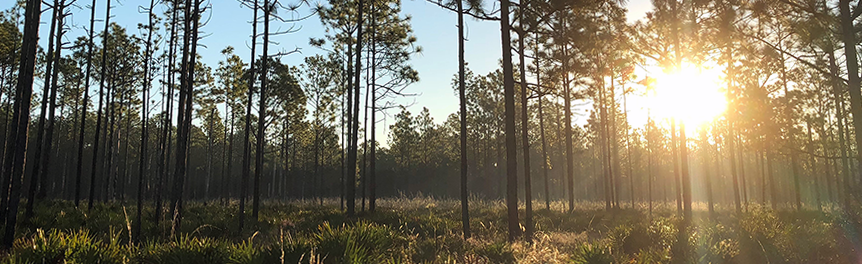
Cary State Forest is dominated by slash pine flatwoods and is located between the St. Mary’s rise and the Atlantic Ocean. The ecosystems on Cary State Forest are varied and include 11 different natural communities: longleaf pine/wiregrass, mesic flatwoods, wet flatwoods, sandhills, basin swamps and cypress domes.
Wildlife species found in the forest include white-tailed deer, wild turkey, bobcat, otter, alligator, great horned and barred owl, wild hog, pileated woodpecker, yellow-throated vireo, pinewood tree frog, and various venomous and non-venomous snake species. The following plant and animal species are listed as endangered, threatened or of special concern and can be found in the forest: gopher tortoise, gopher frog, Sherman's fox squirrel, wood stork, swallow-tailed kite, night-flowering wild petunia and purple honeycomb head.
Many natural communities and their inhabitants are dependent on fire for their very survival. Prescribed burning is one of the most effective tools used in managing Cary State Forest. Prescribed burning helps maintain native plant and animal species and helps prevent uncontrollable, devastating wildfires.
Cary State Forest offers the public a variety of passive, resource-based recreational opportunities, including hiking, RV and primitive camping, wildlife viewing, horseback riding, environmental education and hunting. Most of the current recreation facilities and designated trails are located on the original Cary Tract. Bicycling, hiking and horseback riding are permitted on all forest roads and fire lines on the Cary, Monticello, Thomas Creek and Norfolk Southern tracts unless posted as closed to public access. The forest is open during daylight hours for visitors to enjoy picnicking, hiking, bicycling, fishing, wildlife viewing and horseback riding.
The recreation area on Pavilion Road requires a day-use fee of $2 per adult. Children under 6 are free. Campers are not required to pay the day-use fee.
Both improved primitive and recreational vehicle campsites are available at the Cary Campground, and the Cary group camp has a 100-person capacity for youth group camping. Restroom and shower facilities are available via a short hike from each campsite. Campground reservations can be made on the ReserveAmerica website or by calling 1-877-879-3859.
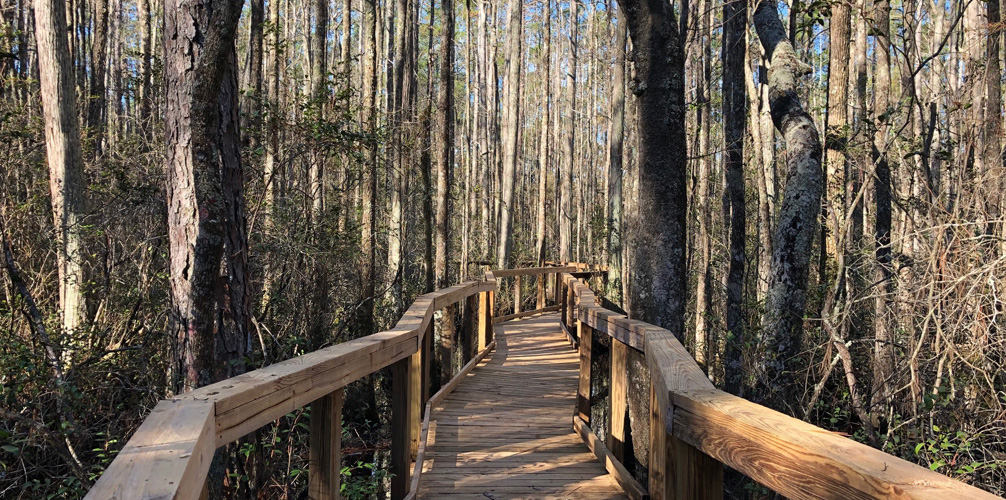
The 1.25-mile Nature Trail at Cary State Forest winds and twists through scenic flatwoods and cypress swamp and includes a boardwalk that takes hikers across the wetlands. This trail is marked with mint green blazes. The Nature Trail boardwalk is dedicated to the memory of Lee and Mimi Adams, whose memorial funds were donated by their estate for the construction of the boardwalk. The Nature Trail is included in the Florida Forest Service's Trailwalker Program.
Horseback riding is a popular activity in the forest, and there are two designated horseback-riding trails. The 12.2-mile Fireline Trail and 7.75-mile Red Root Trail take horseback riders through different forest stands and ecosystems, including mature longleaf pine stands, immature slash pine stands and basin swamps. The Fireline Trail is marked with yellow bands and follows forest roads and fire lines. The Red Root Trail stays along forest roads and is marked with red diamonds. If you plan to take the Red Root Trail, check out our Trailtrotter Program. Hiking and bicycling are also permitted on both of these trails. All horseback riders must have proof of current negative Coggins test results for their horses when on state lands.
The S. Bryan Jennings Pavilion was built and dedicated in 1972 and was renovated in 2018 as an outdoor open-air pavilion. The pavilion may be rented and reserved by the public. The Florida Forest Service and other agencies/groups use the pavilion to teach school groups, Scouts and other groups about forestry and the environment.
Part of Cary State Forest is managed as a Wildlife Management Area by the Florida Fish and Wildlife Conservation Commission (FWC). For specific regulations and dates on hunting, contact the FWC at (904) 758-0525 or visit the FWC website.
Non-hunting recreationists are permitted during hunting season but are encouraged to stay along open forest roads and to wear bright clothing. All campsites, the trailhead, nature trail and pavilion are located in a non-hunting area.
In keeping with its mission to protect and manage Florida's forest resources, the Florida Forest Service has developed rules that apply to all State Forest visitors. Find out more about State Forest fees and rules.
Day use is from sunrise to sunset.
Cary State Forest
7465 Pavilion Rd.
Bryceville, FL 32009-1950
(904) 266-8398 (Monday–Friday)
(904) 266-8396 (Saturday and Sunday)
Email Cary State Forest
Passes are no longer available at the State Forest office. To purchase a pass or make a reservation, visit ReserveAmerica or call 1-877-879-3859.
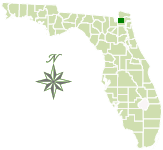
Cary State Forest is located in northeastern Florida near Jacksonville in Nassau and Duval counties.
Directions from Jacksonville:
Take I-10 west to the Baldwin/U.S. Highway 301 exit. Drive north on U.S. Highway 301 for 7 miles. When you get to Bryceville, you will go under a yellow caution light and pass by a fire station on your right. Stay on U.S. Highway 301. The main entrance is on the right, 0.5 miles north of the fire station. Turn right onto Pavilion Road (limerock) and drive to the grass parking area. If you pass Pavilion Road on U.S. Highway 301, you will come to the Florida Forest Service Jacksonville District office on Big Oaks Road.
Directions from Callahan:
In Callahan, drive south on U.S. Highway 301 for 13 miles. When you pass Ford Road, you have only 2.5 miles remaining. Don’t turn in at the Florida Forest Service Jacksonville District office on Big Oaks Road. Continue past it 1.5 miles, turn left on Pavilion Road (limerock), and drive down to the grass parking area.
Total Acreage: 13,385
Counties: Duval, Nassau
Smart device mapping is possible and encouraged in the State Forests. Before visiting a forest, search for “PDF Maps” in the app store to find an app that works for you and download our State Forest map, which is georeferenced.
 296.6 kB
]
737.5 kB
]
104.9 kB
]
296.6 kB
]
737.5 kB
]
104.9 kB
]
Contact:
Justin Rogers
Jacksonville District
Justin.Rogers@FDACS.gov