TALLAHASSEE, Fla. — Today, the Florida Department of Agriculture and Consumer Services and its Division of Plant Industry announced that a quarantine has been established in specific areas of Lee County in response to previously detected giant African land snails. Under the quarantine, it is unlawful to move a giant African land snail or a regulated article, including, but not limited to, plants, plant parts, plants in soil, soil, yard waste, debris, compost or building materials, within, through or from the defined quarantine area without a compliance agreement.
In December 2022, a detection of giant African land snails was confirmed in Lee County, prompting required increased survey and voluntary treatment in the area. Continued survey resulted in an increase in the number of snails found, dead and alive, requiring the department to enact the quarantine announced today. FDACS will continue to use the same treatment methodology for this pest which is a metaldehyde-based molluscicide (snail bait) and is approved for residential use.
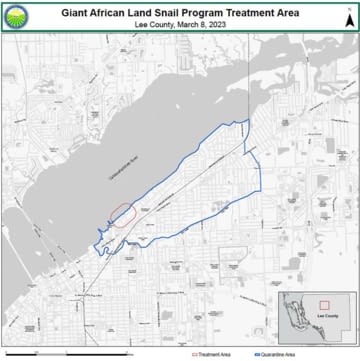
The quarantine is in place starting at the inlet of Billy Creek at the Caloosahatchee River. The quarantine and treatment areas can be found on the map below:
 1.5 MB
]
1.5 MB
]
All publicly available information on giant African land snails and the current quarantine can be found at FDACS.gov/GALS.
The giant African land snail is one of the most damaging snails in the world, consuming at least 500 different types of plants. These snails could be devastating to Florida agriculture and natural areas as they cause extensive damage to tropical and subtropical environments. The snails also pose a serious health risk to humans by carrying parasite rat lungworm, known to cause meningitis in humans. Giant African land snails are illegal to import or possess in the United States without a permit.
For more information about Commissioner Simpson and the Florida Department of Agriculture and Consumer Services, visit FDACS.gov.
###