

Camping

Fishing

Hiking

Horseback Riding

Seasonal Hunting

Paddling
The Florida Forest Service acquired John M. Bethea State Forest in 2001. This State Forest is named in honor of John M. Bethea, who served as State Forester for over 17 years, from 1970 to 1987. Mr. Bethea attended the University of Florida, and in 1941 received a bachelor's degree in forestry from the School of Forest Resources and Conservation. He was a member of the National Association of State Foresters, the National Wildfire Coordinating Group, and the Florida Forestry Association, and he was inducted into the Society of American Foresters Hall of Fame.
Since state acquisition, John M. Bethea State Forest has suffered catastrophic wildfires that have impacted over 80% of the property. Reforestation activities have recently been completed, and over time the State Forest will recover and continue to fulfill resource, environmental and recreational needs.
In the past, this forestland was used for timber production, naval stores production, and cattle grazing operations. Timber remains an important component of forest management. Timber harvesting and other silvicultural activities follow the Florida Department of Agriculture and Consumer Services guide to Silviculture Best Management Practices (BMPs).
Prescribed burning is one of the most important and cost-effective forest management tools used in John M. Bethea State Forest. It not only helps protect this forest from future devastating wildfires but also creates improved wildlife habitats and healthy ecosystems. Prescribed burning is extremely beneficial for bringing newly planted longleaf pines out of the “grass stage." It helps them grow faster and become more resistant to disease and insects.
Using available historical information and also the Florida Natural Area Inventory, the Florida Forest Service has determined that the primary natural forest community in the State Forest is mesic flatwoods. Before state ownership, the majority of this forestland was managed for timber production, so some alteration of natural forest communities has occurred. However, some of the historical natural forest communities, such as basin swamp, dome swamp, wet flatwoods and bottomland forest, remain intact. The Florida Forest Service will focus on restoring all altered sites to known historical status and on managing the natural resources under a multiple-use concept.
Located within the State Forest are 3 miles of river frontage on the scenic St. Marys River, which is ecologically important and provides river access for recreation activities. This part of the river was acquired under the Conservation and Recreation Lands program and the Save Our Rivers program to protect the river’s watershed.
John M. Bethea State Forest is home to Florida black bears, river otters and bobcats. Bird species include hawks, wood storks, bald eagles, grasshopper sparrows and sandhill cranes. There are frequent sightings of alligators, turkeys, white-tailed deer and gopher tortoises.
Plans have been developed to increase the recreational opportunities in the forest. The new Catface Corner Recreation area provides visitors with primitive camping opportunities at one of the four campsites available for reservation. A canoe launch at Maple Set Recreation Area allows access to the headwaters of the St. Marys River. Maple Set also offers a picnic area and a riverside trail for day use.
For equestrian visitors, the forest offers a 7-mile horse trail loop that passes through both young and mature pine stands on the border of Ellis Bay. Proof of a current negative Coggins test is required for all horses. To support the horse trail, a parking lot has been built at the trailhead on the south end of the forest. Heading north on county road 250 (North of Taylor), turn right onto Thannie Harvey Road and continue travel for about 1 mile. then turn left onto Forest Road 27. Equestrian Trailhead and Parking lot will be on the left about three quarters of a mile.
John M. Bethea State Forest is open to regulated hunting and fishing in cooperation with the Florida Fish and Wildlife Conservation Commission and is managed as a part of the Osceola Wildlife Management Area. Small ponds are scattered throughout the forest, providing enjoyable fishing areas in addition to the St. Marys River. Non-hunting recreationists are encouraged to check the Wildlife Management Area regulations and season dates before visiting the forest.
In keeping with its mission to protect and manage Florida's forest resources, the Florida Forest Service has developed rules that apply to all State Forest visitors. Find out more about State Forest fees and rules.
Day use is from sunrise to sunset.
John M. Bethea State Forest
11656 State Road 2
Sanderson, FL 32087
(904) 259-4688
Email John M. Bethea State Forest
Passes are no longer available at the State Forest office. To purchase a pass or make a reservation, visit ReserveAmerica or call 1-877-879-3859.
John M. Bethea State Forest is located approximately 12 miles north of Glen St. Mary, Florida, in northern Baker County near the Florida-Georgia state line. This 37,735-acre State Forest establishes a continuous wildlife corridor between the Okefenokee National Wildlife Refuge and the Osceola National Forest.
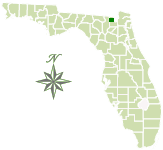
Total Acreage: 37,735
Counties: Baker
Smart device mapping is possible and encouraged in the State Forests. Before visiting a forest, search for “PDF Maps” in the app store to find an app that works for you and download our State Forest map, which is georeferenced.
 566.6 kB
]
210.8 kB
]
159.5 kB
]
566.6 kB
]
210.8 kB
]
159.5 kB
]
Contact:
James Karantinos
James.Karantinos@FDACS.gov
