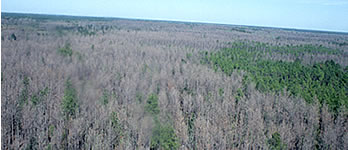
Extensive pine mortality during an SPB outbreak on Florida's Ocala National Forest
The southern pine beetle (SPB) is an aggressive insect pest that has devastated pines in yards and forest tracts throughout northern and central Florida. Like other species of bark beetles, populations of the SPB feed in the inner bark of susceptible pines and usually attack trees that are stressed due to overcrowding, competition, injury, drought, disease or old age. When these types of stressful forest conditions occur in combination over a widespread area, SPB outbreaks can develop, during which even healthy pines can be mass attacked and rapidly killed. Such conditions led to Florida's most extensive SPB outbreak in 2001, when nearly 2,900 infestations were detected in 34 counties, covering 17,600 acres and resulting in the loss of several million dollars of pine timber.
Forest management, however, can help prevent SPB outbreaks and damage, as well as enhance recreational opportunities, reduce the risk of loss from wildfires, and increase the economic potential of forest land. Good forest management pays in the long run. As a non-industrial private landowner in Florida, you may qualify to have a forest management plan drawn up for your property at no cost, or to receive financial assistance with forest management practices that reduce the risk of SPB attack.
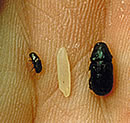 | SPB (left) compared to grain of rice and black turpentine beetle. Photo: Southern Forest Insect Work Conference, www.forestryimages.org |
Frequently Asked Questions
What factors make pines susceptible to SPB attacks?
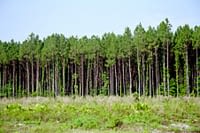
A dense, unthinned, susceptible stand of trees
As young pine stands grow, trees begin to crowd and compete with one another for space, sunlight, water and nutrients. In most plantations, this crown and root competition begins as early as age 10 to 15 years, or even earlier on better-quality sites. If a dense stand is not thinned by this point, radial growth and vigor decline and trees become very susceptible to SPB and other bark beetles. Similarly, pine stands with a buildup of competing hardwood and other underbrush beneath the main canopy are susceptible to bark beetles, especially during droughts or other periods of environmental stress.
Other factors that increase stand susceptibility to bark beetles include: loss of vigor associated with age, disease or root damage; injuries or wounds to pines; and inappropriate pine species for a given site.
What can I do to help prevent SPB attacks?
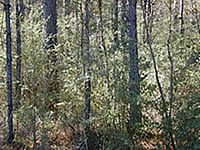
Thick hardwood competition beneath pines. Photo: Jim Meeker, USDA Forest Service
Thin dense, overcrowded pine stands to increase the vigor of remaining trees, make beetle spread more difficult due to wider tree spacing, and produce higher value wood products (sawtimber) at final harvest. Thin stands to a basal area of 80 square feet per acre or less, giving individual tree crowns adequate room to expand.
Prescribe burn to reduce competing hardwood vegetation and underbrush beneath pines, reduce wildfire hazard, and enhance certain wildlife, recreation and aesthetic values. Often, very dense buildups of competing vegetation under the pine canopy should first be reduced by mechanical means.
Minimize or avoid wounds to pines during harvesting operations to reduce the production of pine odors that attract bark beetles. For similar reasons, don't conduct thinnings during bark beetle outbreaks or near active infestations.
Harvest and regenerate stands of mature, senescent pines. If removal of old pines conflicts with other management objectives, monitor such pines frequently for bark beetle activity. Remove pines weakened by disease, injury, lightning or other stress to increase overall stand vigor and resistance to bark beetles.
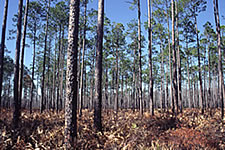
A stand managed through thinning and prescribed burns
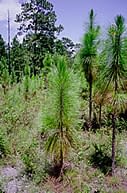
Avoid planting pines off-site, especially loblolly and shortleaf pines, which are more susceptible to the SPB than longleaf (pictured) or slash pines. A forester can help you determine which species are appropriate for a given site.
Promote a diversity of tree species and ages in the forest landscape, which can make susceptible trees or preferred host species more difficult for bark beetles to find.
What if an SPB infestation occurs?
Due to a very effective odor-driven communication system used by the SPB, small infestations can expand by more than 50 feet per day, quickly resulting in many acres of dead pines. If you detect enlarging patches of recently killed or dying pines on your property, contact your county forester or county extension office for an evaluation of the situation. If they determine the problem is an SPB infestation, the best control option is usually to cut, remove and process all infested trees, plus a buffer strip of uninfested green trees, as soon as possible.
What are the signs of SPB attack?
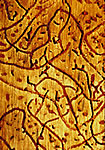
Signs of SPB attack may include: popcorn-sized resin globs or "pitch tubes" in the bark crevices, winding "S-shaped" galleries under the bark, and clusters of pines with crowns fading from green to yellow to red. Other bark beetle species (Ips, black turpentine beetles) can produce similar symptoms, but the S-shaped gallery pattern under the bark is distinctive of the SPB.
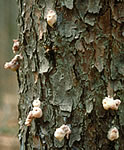 | Left: SPB pitch tubes. Photo: Tim Tigner, Virginia Department of Forestry, www.forestryimages.org Right: SPB galleries under the bark. Photo: Ronald F. Billings, Texas Forest Service, www.forestryimages.org |
|
What is being done to monitor SPB?
Each spring, the Florida Forest Service conducts an SPB trapping survey in central and northern Florida. This survey monitors the numbers of SPBs and their predators captured in pheromone-baited flight traps, and the results are used as an early-season prediction of SPB activity levels. Also, the Florida Forest Service conducts aerial survey flights to detect and monitor SPB infestations.
Are management assistance programs available?
Programs that provide technical and financial assistance with forest management planning and practices are available periodically. To find out what programs may be available currently, contact your county or district Florida Forest Service office.
The Benefits of Good Forest Management Practices
Good forest management practices help prevent bark beetle attacks and result in more productive pine stands.
Due to the limited options for remedial control of bark beetles, the best way to prevent losses is to manage pine stands so that they are healthy, vigorous and resistant to attack. Give pines plenty of sunlight, space to grow, freedom from competing plants, and protection from injury, and plant on proper growing sites. All of these practices are compatible with the production of high-value wood products and other forest management goals.
 |
 |
 |
Authored By:
Bud Mayfield, FDACS, Florida Forest Service
Galen Moses, FDACS, Florida Forest Service
Jarek Nowak, University of Florida IFAS
Rev. June 2004