The Florida Department of Agriculture and Consumer Services, Division of Plant Industry (FDACS-DPI) conducts surveys for invasive mollusks to prevent invasions of agricultural pests. A group of trained inspectors make up the Agricultural Snail and Slug Inspection and Survey Team with the goal of preventing the early establishment of snails and slugs by targeting high risk sites throughout the state. The snails of great concern include:
Giant African Land Snail
In 2021, FDACS, in collaboration with the U.S. Department of Agriculture Animal and Plant Health Inspection Service Plant Protection and Quarantine program (USDA APHIS PPQ), declared the eradication of the giant African land snail in South Florida. For more information on this pest or the eradication program, see our giant African land snail webpage.
Horntail Snail
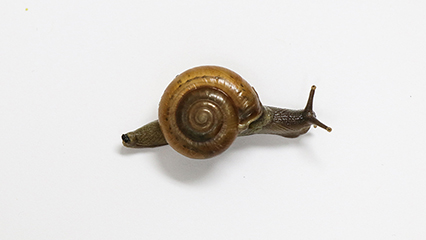
In September 2020, FDACS positively identified the presence of the horntail snail (Macrochlamys indica) in Miami-Dade County. This was the first time this snail had been detected in the United States. The discovery led to a survey and control effort which immediately stopped the snail’s spread. Currently, its population is being suppressed and treated with immediate action if detected in nursery stock.
Description
The horntail snail is a well-known pest in India where it is reported to feed on a wide variety of commercial crops, including lettuce, beans, yams and chrysanthemums. It is mostly active at night and after rainfall. It has a delicate, amber-colored shell that is about the size of a dime. The snail prefers cool, damp locations, so it may be found under pots or in moist soil. During dry, hot weather, it may burrow in the ground. In Florida, this species is associated with dead plant material and has not become an agricultural pest.
Program Resources
-
Horntail Snail Pest Alert
[
 588.3 kB
]
588.3 kB
]
-
Metaldehyde for Controlling Snails and Slugs FAQ (English Version)
[
 292.5 kB
]
292.5 kB
]
-
Metaldehyde for Controlling Snails and Slugs FAQ (Spanish Version)
[
107.3 kB
]
Brown Garden Snail
The brown garden snail was introduced to California in the 1850s as a source of escargot. It has a yellow or horn-colored shell with chestnut-brown spiral bands interrupted by yellow flecks or streaks. All plant material coming into Florida from states with brown garden snail are required to have a certificate confirming the plant material has been inspected and found free of the pest. The snail has a variety of hosts including the California boxwood and Italian cypress, but it is only occasionally intercepted on plant shipments to Florida and has yet to become an established pest.
Program Resources
- Brown Garden Snail [ Adobe PDF Document ] (University of Florida Institute of Food and Agricultural Sciences)
-
Entomology Circular No. 83
[
178.6 kB
]
Snail ID Sheet
Think you've found an invasive snail? Refer to our
Snail Identification Sheet
[
1.5 MB
]
. Still not sure? Email a photo for identification to DPIHelpline@FDACS.gov.
Public Health Concerns
Any terrestrial snail in Florida has the potential to be an intermediate host of rat lungworm, which can cause meningitis in humans. Gloves are advised when handling snails. Learn more about rat lungworm [ Adobe PDF Document ].