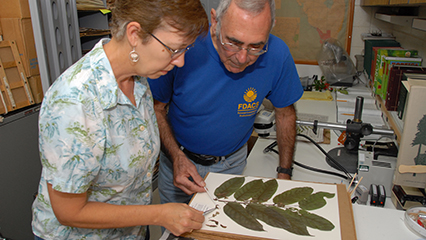
Can't figure out what the flower or plant in your yard is? Need help determining what kind of bug you found outside? Here's how to properly submit a plant or insect specimen to the Florida Department of Agriculture and Consumer Services' (FDACS) Division of Plant Industry for identification.
Please fill out the Specimen Submission Form [ Adobe PDF Document ] and mail the form with the sample/specimen to:
Florida Department of Agriculture and Consumer Services
Division of Plant Industry
The Doyle Conner Building
1911 SW 34th St.
Gainesville, FL 32608-7100
How to Fill Out the Specimen Submission Form
Read our
Specimen Submission Form Hints
[
 194.5 kB
]
.
194.5 kB
]
.
This video will tell you more:
How to Submit an Insect, Spider, Snail and Other Invertebrate for Identification
Submit a Photo
If the specimen is large enough, it may be identified by photograph. To submit a photo for identification, email it to DPIHelpline@FDACS.gov. Be sure to include your contact information and any related information.
Submit a Specimen
If you are mailing a specimen, see our
tip sheet
[
99.1 kB
]
or this video:
How to Submit a Specimen for Plant Disease Identification
Include fresh material in ample quantity with several examples of the various symptoms that are of concern. If possible, include as many identifiable stages of the disease as are represented. Recently developed symptoms usually afford the best material for diagnosis.
Remember that if insect or nematode involvement is indicated by the syndrome, the sample may be divided to allow other scientists to evaluate the problem. Also, please include some healthy plant material if possible for positive botanical identification.
To learn more, see our
tip sheet
[
469.4 kB
]
or this video:
How to Submit a Healthy Plant for Identification
Include several leaves attached to a twig and flowers or fruit, if available. Wrap the sample in dry paper towels and double bag it with the Specimen Submission Form in the outer bag.
Complete a separate form and use separate bags if you send more than one plant for identification. Use an overnight service, if possible. Plants last only two to three days in the mail.
To learn more, see our
tip sheet
[
178.6 kB
]
or this video:
How to Submit a Soil Sample for Nematode Identification
Nematodes are not uniformly distributed in the soil. In most cases they occur in clusters, which makes them easy to miss when you are collecting a soil sample. Therefore sufficient sampling must be implemented to enhance nematode detection.
Each sample should be approximately 1 pint, or about the size of one large grapefruit. Do not place sample submission forms inside the plastic bag with the sample.
To learn more, see our
tip sheet
[
98.2 kB
]
or this video: