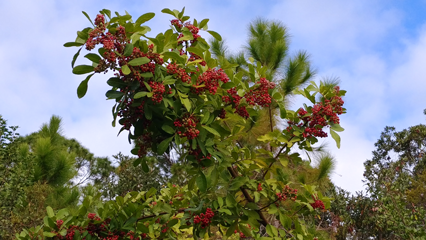
Brazilian peppertree, Schinus terebinthifolius Raddi, is an exotic, invasive shrub/tree that originates from Argentina, Brazil and Paraguay. It has been introduced to many countries around the world as a cultivated ornamental, prized for the many bright red berries that it puts on each winter. These fruits, also known as drupes, can be dried and consumed as pink peppercorn, hence the name Brazilian peppertree. Other common names include Christmas berry tree and Florida holly.
Brazilian peppertree was introduced to Florida as an ornamental plant at least as early as 1898, possibly as early as the 1840s, and has since become one of the most aggressive and widespread invasive plants in the state, covering more than 750,000 acres. It specializes in outcompeting other plants, threatens native and agricultural landscapes, and can cause allergic reactions in people sensitive to volatiles released by the leaves, flowers and fruits. A biological control agent, the Brazilian peppertree thrips, Pseudophilothrips ichini (Hood) (Thysanoptera: Phlaeothripidae), was approved for release in May 2019 after rigorous testing demonstrated it would affect only Brazilian peppertree.
Background

Female Brazilian peppertree with berries/drupes
Brazilian peppertree is listed as a noxious weed by the Florida Department of Agriculture and Consumer Services (FDACS), as a Category I invasive plant (“species which are altering native plant communities by displacing native species, changing community structures or ecological functions, or hybridizing with natives”) by the Florida Exotic Pest Plant Council, and as a prohibited plant, meaning that sale and movement are prohibited, by the Florida Department of Environmental Protection. In addition to Florida, Brazilian peppertree occurs in Alabama, California, Georgia, Texas, Hawaii, Puerto Rico and the Virgin Islands.
There are many factors that contribute to Brazilian peppertree's success and resilience as an invasive species and make it difficult to manage. Brazilian peppertree grows quickly, spreads rapidly, tolerates a wide range of environmental conditions, and is a prolific seed producer.

Berries are numerous and grow in dense clusters.
One study in Brazil found that female plants produced an average of more than 8,000 fruits per plant. The seeds have an unfortunately high germination rate (up to 100% according to Jacques et al., 2007). The fruits are eaten by birds and mammals, which act as seed dispersers.
Once seeds germinate, they are fast growing and Brazilian peppertree rapidly invades disturbed habitats such as roadways, ditches, canals and abandoned lots, quickly establishing a foothold from which to radiate out into undisturbed habitats. Once established, it is resilient and difficult to eradicate. Brazilian peppertree has at least some tolerance for shade, flooding, fire and even brackish conditions, making it a major invader of the Everglades.
Brazilian peppertree also produces allelopathic compounds that can suppress the growth of surrounding vegetation. For these reasons it often successfully outcompetes native plants, producing dense monocultural stands that are unrelenting in their expansion. It is considered a major threat to natural and disturbed areas as well as agricultural and pastural lands. It also poses a significant obstacle to ongoing coastal and Everglades restoration efforts. As if all of that wasn’t enough, Brazilian peppertree is a member of the family Anacardiaceae, which includes poison ivy, and can cause allergic reactions and respiratory illness in sensitive individuals exposed to fluids, pollen or volatiles released by the leaves, flowers and fruits.
Traditional Control
Chemical and mechanical control practices (cutting, burning, flooding and herbicide application) are routinely used, often in combination, to combat stands of Brazilian peppertree. However, these conventional methods are expensive, labor-intensive, non-selective and often provide only temporary relief. (Note that we do not recommend burning Brazilian peppertree. The smoke can be highly irritating to eyes, skin and lungs.) Even after cut-stump treatments, where the plants are cut down to a stump and herbicide is applied, they sometimes pop right back up from basal shoots (also known as suckers).
Additionally, these conventional control methods can have negative effects on non-target species and can increase water pollution, which poses problems in coastal mangrove forests, wetlands and other ecologically sensitive areas that are prone to infestation by Brazilian peppertree. State agencies spend almost $3 million annually on control of Brazilian peppertree and are barely keeping up. We need additional tools in our toolbox, and that is where biological control enters the picture. Biocontrol has the potential to provide a low-cost, safe, persistent and selective means to reduce Brazilian peppertree pressure throughout Florida and other infested regions of the United States.
Biological Control
The idea of using biocontrol to manage Brazilian peppertree is not at all new. In fact, researchers have been working on biocontrol of Brazilian peppertree in Florida since at least 1990. If you’re wondering why we’re only just getting around to releasing insects on this invader, you aren’t alone. The process of finding, testing and obtaining regulatory approval for release of promising insect biocontrol agents is long and involved. Researchers must first explore the native habitat of the target weed to attempt to find insects that feed on it. Once a potential agent has been positively identified, it is imported into a quarantine facility in the invaded range, where it takes years for biocontrol scientists to learn how to rear the insects and to systematically conduct host range tests to determine what the potential impacts could be if it is released into the wild. Host range testing involves attempts to feed a wide variety of non-target plants to the potential insect agent to see if they are capable of feeding, surviving, or sustaining multiple generations on anything other than the target weed. Close relatives, plants with threatened or endangered status, related crops, related ornamentals and some distant relatives are generally included. Significant feeding and/or survival found on non-target plant species generally eliminates a potential biocontrol agent from consideration for release, with exceptions sometimes made for feeding on other invasive species. If an agent is deemed to have minimal potential non-target effects, the process for seeking regulatory approval for release can begin.
Meet the Brazilian Peppertree Thrips
Thrips are small, feathery-winged insects that feed on plants. You may be familiar with thrips if you’re in the business of growing plants for a living or as a hobby. Some important species act as common pests in gardens and greenhouses in Florida. You might be wondering, if thrips are known to be pests, then why would we purposely release them? The reason is that the species of thrips that we raise won’t bother the plants you grow for a living or for fun. These small (2-3 mm) black insects are native to Brazil, and we know from the research that they feed selectively on Brazilian peppertree. They can’t survive by feeding on your garden, crop, Florida native, or greenhouse plants. We know this as the result of years of testing aimed specifically at uncovering this species’ host range.
The way that Brazilian peppertree thrips feed is to scrape away little bits from the surface of leaves and stems and then suck up the juices that ooze from the resulting wounds. They don’t chew holes in the plants like a beetle or a caterpillar does. The injuries that they make are relatively small, but because they tend to gather and feed in groups on new growth (the most tender part of the plant), they can do some impressive damage. They are tiny but mighty! They also have a high reproductive rate and they’re easy to rear under laboratory conditions, which is helpful for the kind of work that we do. The adults lay eggs on the growing tips of the plants, and the larvae feed on the tips and down the stems as a group, causing the new growth to wilt and die. Damaged tips will not flower or produce fruit, so the insect has the potential to reduce both canopy cover and fecundity of the plant in the field. The thrips may also increase the Brazilian peppertree's susceptibility to other diseases and abiotic stressors. Check out the damage they’ve done to plants in our lab!
Rearing and Releases
The Brazilian peppertree thrips was approved and permitted for release on Brazilian peppertree in the state of Florida by the U.S. Department of Agriculture's Animal and Plant Health Inspection Service (USDA APHIS) in May 2019. In October 2019, the first 40 adult thrips were delivered to the FDACS Division of Plant Industry for mass rearing. We raise our thrips in a large building called the Biological Control Rearing Facility, which was designed and built specifically for mass-rearing biological control insects (a.k.a. agents). In the time since we received those first 40 adults, many thousands of new adults have been produced by our crew of technicians.
Simple PVC frame cages with custom-sewn, fine mesh sleeves are used to contain the thrips on potted Brazilian peppertree plants. High output fluorescent light banks are suspended above our cages to provide supplemental lighting for the plants and insects indoors. Large rolling racks are used to hold our cages and light banks. The racks hold everything up at a comfortable height for working, and the wheels allow us to move things around so that we can maximize our use of available indoor rearing space.
Just before a new generation of adults is ready to emerge from the plants in our cages, we cut back the plants and add passive traps. Learn how our 3D Printing Lab helped us create these traps. New adults emerge and are attracted to the plant material in the top of the trap. From here, it's easy to collect and transfer them into temporary holding containers to await release either into the field, or into new rearing cages.
Adults that don't go back into rearing to produce the next generation of thrips in our colonies, go into the field for release. Currently we are only releasing Brazilian peppertree thrips for research purposes.
The Division of Plant Industry collaborates with the University of Florida’s Biological Control Research and Containment Laboratory and the USDA’s Invasive Plant Research Laboratory on mass rearing, release and post-release monitoring of the thrips. It is still too early to say what the field impacts will be once these insects establish self-propagating populations, but hundreds of thousands of insects have been released around the state since May 2019 to kick-start establishment. Stay tuned! We will be mass-rearing, releasing and monitoring the success of this promising new biocontrol agent for many years to come.