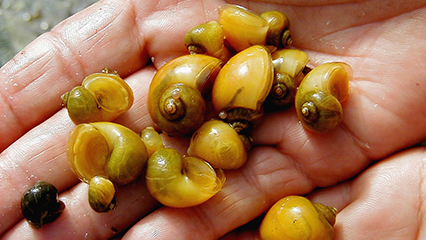
Aquaculturists produce game fish fingerlings (largemouth bass, sunfish and catfish), triploid grass carp, aquatic snails, algae, live feeds (such as rotifers and copepods) and baitfish to satisfy specialty local, national and international markets.
Licenses and Permits
If you are interested in commercially culturing these species in Florida, you must apply for an Aquaculture Certificate of Registration and comply with
Aquaculture Best Management Practices
[
 960.9 kB
]
.
960.9 kB
]
.
Grass Carp
Grass carp (Ctenopharyngodon idella) is a restricted species in Florida. A permit from the Florida Fish and Wildlife Conservation Commission (FWC) is required for stocking grass carp for weed control. Visit the FWC's website for more information about grass carp permits.
Snails
Apple snails may have restrictions on their movement and may require a permit through the U.S. Department of Agriculture's Animal and Plant Health Inspection Service (APHIS) for interstate or import/export movements. Visit the APHIS Snails and Slugs webpage for more information.
See additional regulations on snails.
Baitfish
Baitfish aquaculture is a developing industry in Florida. With marine baitfish such as pinfish, Atlantic croaker and pigfish in high demand, production techniques are currently being researched. Most baitfish are wild caught, so size, supply and quality are highly variable. When baitfish aquaculture becomes established in Florida, aquaculturists could provide baitfish of a consistent size throughout the year to meet the demands of the recreational and commercial fishing industries.
For more information about baitfish aquaculture and current research, please visit the University of Florida Indian River Research and Education’s aquaculture webpage.
Algae
Live feeds, such as algae, rotifers, copepods and brine shrimp, can be raised for multiple markets as a first feed for larval fry or for filter-feeding organisms. Algae is a complete protein with essential amino acids, so it has high nutritional value and can be grown as food for humans too. Also helpful in pollution control, algae can be used as a biofilter in water treatment facilities and on farms to remove nutrients and other pollutants from wastewater and runoff. In addition, algae can be used as fertilizer and as an energy source; it can be used to produce bio-diesel, bioethanol and bio-butanol.