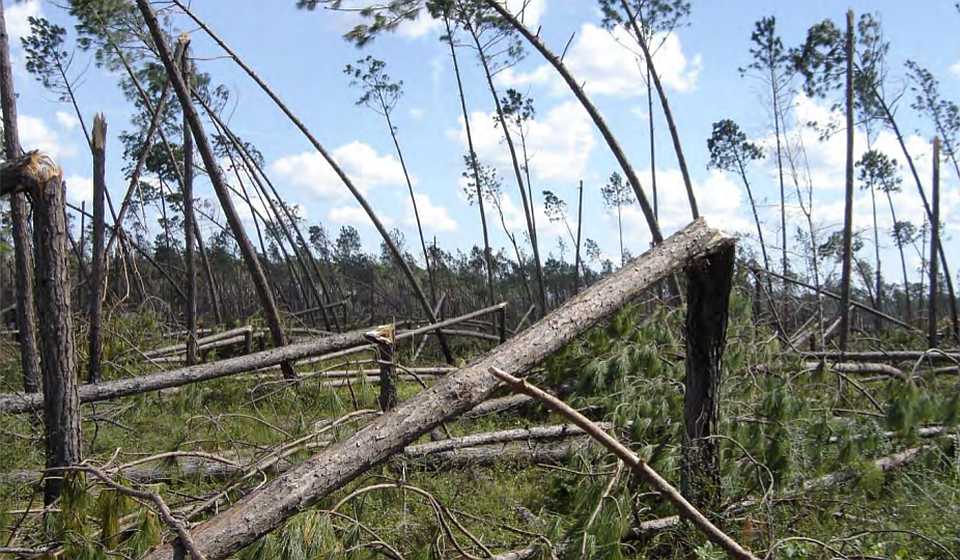
Strong storms and hurricanes are a fact of life in Florida. When preparing for the next storm event, timberland owners should also plan for and be ready to respond to timber damage on their property. Past hurricane seasons have shown that forest resources can be severely damaged by hurricanes and other casualty events.
County Foresters Can Help
Do you have questions regarding storm-damaged timber? Contact your local County Forester for professional forestry advice. They can make specific recommendations pertaining to the current and future management of your property. Find your County Forester.
Evaluating Storm-Damaged Trees
Efforts should be concentrated on evaluating trees and forest stands as soon as possible, and then harvesting them, if necessary. The Florida Forest Service strongly recommends that landowners seek the help of a professional forester during this process.
- Assessment and Management of Hurricane Damaged Timberland by UF/IFAS
-
Assessing Damage and Restoring Trees After a Hurricane by UF/IFAS
[
 3.5 MB
]
3.5 MB
]
- Storm Planning and Recovery of Trees by the National Arbor Day Foundation
Forest Health Issues
Trees subjected to environmental stresses or injuries are usually more vulnerable to damage caused by insects and diseases. Storm-damaged trees are prime targets for a host of destructive insects and diseases. Unfortunately, insect pests, as well as certain tree pathogens (especially fungi), are actually better at recognizing trees under stress than most tree enthusiasts. As a result, stressed trees may go completely unnoticed until they are "suddenly" damaged or killed by insects or diseases. Some insects are actually attracted to stressed trees by chemical signals (odors) released into the air by trees in response to stress. It is only when trees are seriously injured or stressed that they lose their natural ability to ward off infections by these organisms and fall victim to the attack. Examine your trees often for the appearance of any unusual symptoms. Visit the Forest Health webpage for more help.
Tax Issues
The first thing a landowner should do in the wake of a storm is document the event and the damage incurred. Save a copy of the local newspaper to document the storm and take pictures of the timber damage before any salvage harvesting begins. Timber losses from natural disaster may be claimed as a casualty loss if none of the timber is harvested. If the timber is harvested, it can be claimed as an involuntary conversion. Tax rules governing the applicability of casualty losses and involuntary conversions are complex, and the advice of a professional accountant or tax lawyer should be sought.
Salvage Your Timber
It may be difficult to sell your timber due to the massive amount of damaged wood on the market. In addition, prices will be depressed due to the difficult logging conditions, which drastically reduce loggers’ productivity. Trees that can be sold for veneer and sawtimber products should be harvested first. After four to six weeks, a blue stain fungus will degrade the quality of these high-valued trees and they will have to be sold for pulpwood. Trees being sold for pulpwood should be removed within eight to 12 months.
Find consulting foresters and technicians, urban forestry consultants, prescribed burning consultants and wildlife consultants for Florida in the Forest Services Vendor Database.
The Forest Products Network provides information on more than 400 primary and secondary wood-using companies in Florida.
-
Sample Timber Sale Contract
[
29.4 kB
]
Recovery Resources
The U.S. Department of Agriculture (USDA) has several programs to assist landowners with the recovery process, from annual crops to livestock to forests. The Emergency Forest Restoration Program for non-industrial private forest landowners provides up to 75% of the cost to implement emergency restoration practices. Learn more about this program as well as others at the USDA's Farmers.gov/recover website.
The Florida Land Steward Program's Hurricane Preparation and Recovery webpage provides landowners with a variety of information, including recently posted YouTube videos specifically addressing hurricane preparedness and recovery information for forest landowners.
Reforestation
The process of reforestation should involve careful planning, starting when you harvest your timber. The manner in which your timber is harvested will affect the timing, and potential methods of site preparation and planting. There may be a federal Forestry and Wildlife Cost Share Program available to help you with the costs of reforestation.
Contact Us
The Florida Forest Service through its network of foresters provides reforestation assistance to landowners. To learn more, contact the County Forester in your area.