RESTORE is an acronym referring to the Resources and Ecosystems Sustainability, Tourist Opportunities and Revived Economies of the Gulf Coast States Act of 2012. The objective of the RESTORE Landowner Incentive Program is to increase the acreage of healthy pine ecosystems in Florida by helping non-industrial private forest (NIPF) landowners to make the long-term investment required to establish and/or maintain this valuable ecosystem. This long-term investment improves water resources and improves forest health. The program offers NIPF landowners incentive payments for conducting certain approved forest management practices that establish or improve forest health and water resources. This program is administered by the Florida Department of Agriculture and Consumer Services' (FDACS) Florida Forest Service and is funded through a grant from the U.S. Forest Service. The program’s public outreach will seek to engage agricultural, silvicultural and environmental stakeholders, as well as local governments, nonprofits and community organizations.
The Florida Forest Service will use these program funds to improve water quality and quantity in Florida by providing cost-share reimbursement payments to qualified applicants for completing eligible forest management practices. The eligible cost-share activities under this program are tree establishment practices (site preparation, seedling purchase and planting) and timber stand improvement (TSI) practices (first pulpwood thinning, underbrush treatment and prescribed burning).
How to Apply
The 2025 program will be accepting applications from January 13-March 27, 2026. To initiate the application process, the landowner, or an authorized representative of the landowner, must contact the Florida Forest Service (FFS) County Forester assigned to the county where the property is located.
The application process is comprised of the following six general steps in order:
- The landowner, or an authorized representative of the landowner, will contact the appropriate FFS County Forester to express their intention to apply for the program and to provide all required applicant information as defined below.
- The FFS County Forester or an FDACS designee will schedule and conduct a site visit to determine the eligibility of the property according to the rules of the program and to verify which practices, if any, are appropriate for the site.
- Following the site visit, the FFS County Forester or an FDACS designee will confirm with the landowner (or the landowner’s authorized representative) the acreage and practices the landowner is applying for through the program.
- The FFS County Forester or an FDACS designee will use the required applicant information supplied by the landowner (or the landowner’s authorized representative) and information collected during their site visit to initiate a new application and complete Attachment A.
- The FFS County Forester or an FDACS designee will sign the completed Attachment A document and send it to the landowner (or the landowner’s authorized representative). Once reviewed and signed by the landowner (or the landowner’s authorized representative), a copy of the fully signed Attachment A document will be submitted to the FFS County Forester or the FDACS designee who signed Attachment A.
- The FFS County Forester or an FDACS designee will email the fully signed Attachment A document, stand map and substitute W9 to Grants@FDACS.gov, completing the application process. Once all required applicant information and a fully signed Attachment A document, stand map and substitute W9 are emailed, the application is considered complete and submitted.
Interested applicants can find more information about the program and the application process by viewing the request for application. Applications will not be accepted by mail. After the application period has closed, applicants will be ranked and notified of the results by an official letter. No on-the-ground work may commence before a contract is executed between the successful applicant and FDACS.
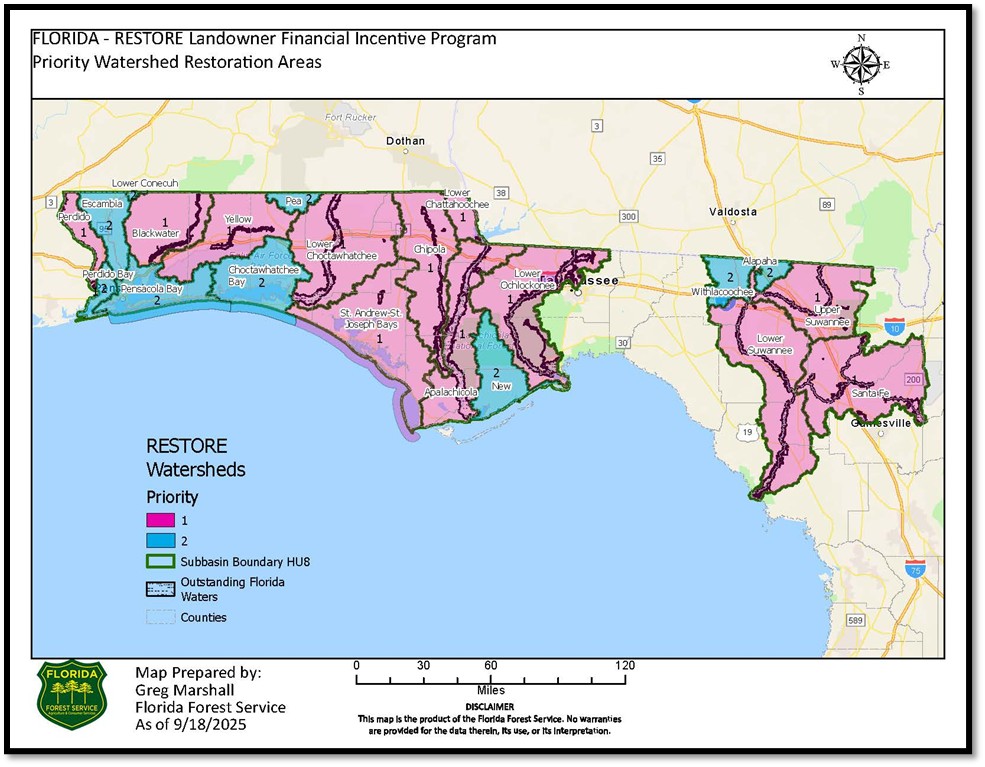
Applicants are limited to non-industrial private landowners; county or local governments; or legally organized and registered nonprofit organizations, entities or institutions owning their own lands. Florida landowners with a practice area of a minimum of 10 acres are encouraged to apply. Funding opportunities max out at 250 acres of forest establishment and TSI. For an application to be eligible, the property must be located within the designated RESTORE project area.
Practice Categories
Category 1: Reforestation or Afforestation, Including Prescribed Burning, Mechanical, Chemical Site Preparation, Planting and Seedlings
When reforesting an area, site preparation must be deemed necessary by the FFS County Forester or FDACS designee to improve the survival and growth of planted seedlings. Site preparation practices eligible for reimbursement include prescribed burning and mechanical and chemical control of competing vegetation. Applicants may apply for multiple practices on the same acreage.
Prescribed burning can be used to clear logging debris from the planting site or as a control method for grasses and woody vegetation when deemed appropriate and approved by an FFS Forester or FDACS designee. Where possible, debris piles should be used instead of windrows. Prescribed burning must be done in accordance with Chapter 590, Florida Statutes, and Chapter 5I-2, Florida Administrative Code, local laws, regulations and burning restrictions. A burning authorization must be received from FFS before any burn may be conducted.
Mechanical site preparation includes root raking, bedding, shearing or any other activity approved by the FFS Forester or FDACS designee to remove large woody debris that causes restrictions on the other site preparation practices or prepare the soil for pine seedling establishment. This can also be used for the removal of competitive species that are not affected by other site preparation methods.
Chemical site preparation is herbicide treatment prior to pine seedling planting to reduce competition of grasses and woody vegetation to improve pine seedling growth and survival. This is recommended where prescribed burning is a more restrictive option. To ensure effectiveness, the following conditions should be met:
- The landowner should contact an herbicide applicator to determine the appropriate herbicide, application rate, and timing of application to use for the site. FFS can provide a list of herbicide applicators in the area.
- The applicator must apply the treatment consistently with all label requirements. Consideration should be given to maintaining soil productivity, preventing erosion and minimizing costs.
Planting
- Machine-planting method used with a wheeled or tracked machine. This category includes any mechanical planting method, such as v-blade planting.
- Hand-planting method used by an individual with a dibble or other hand tool.
Seedlings must be planted to the following standards to encourage good survival and growth:
- Seedling type:
- Containerized pine seedlings are grown in soil plugs and shipped with soil formed around the roots.
- Bareroot pine seedlings contain no soil around their roots when shipped.
- The only species allowed to be planted through this program will be longleaf pine, loblolly pine, slash pine and sand pine.
- Furrow or planting bar depth must be appropriate for the seedlings.
- The seedlings must be planted upright.
- The roots must be vertical with no “U” or “J” rooting.
- Seedlings must be packed tightly in the soil so they cannot be moved by pulling upward on the top needles.
- Planting density must be between 425 and 605 trees per acre to receive a cost-share reimbursement payment.
- The applicant must notify the FFS Forester or designee when planting begins and is completed. FFS will coordinate a planting check within three weeks after planting has begun.
Category 2: Prescribed Burning Understory
Prescribed burning under an existing pine stand can be used to reduce fuel load, maintain habitat and/or control pest or disease when deemed appropriate and approved by an FFS Forester or FDACS designee. Prescribed burning must be done in accordance with Chapter 590, Florida Statutes, and Chapter 5I-2, Florida Administrative Code, local laws, regulations and burning restrictions. A burning authorization must be received from FFS before any burn may be conducted.
Category 3: First Pulpwood Thinning
A first pulpwood thinning can be used to reduce basal area to improve the health of an existing pine stand. The stand will have to have a basal area of at least 110 square feet to qualify. After treatment, the average basal area of the stand must be at least 50 square feet per acre but must not exceed 80 square feet per acre. Clearcuts, patch-cuts or any harvests other than first thinnings do not qualify. A fixed, dollar-per-acre incentive will be paid to the landowner for implementation of this practice, regardless of profits gained from sale of the harvested timber. Documentation (e.g., scale tickets, volume reports) showing tons of pulpwood removed from the stand must be retained and presented to the local FFS forester.
Category 4: Mechanical Underbrush Treatment
The treatment must be used to control undesirable competition to existing pine trees with a Gyro-trac, Posi-trac, Brown Tree Cutter or equivalent equipment. This will enhance habitat, reduce fuel load and improve forest health.
Category 5: Chemical Underbrush Treatment
Chemical underbrush treatment is herbicide treatment to reduce competition of grasses and woody vegetation to improve forest health and function. This is recommended where prescribed burning is a more restrictive option. To ensure effectiveness, the following conditions should be met:
- The landowner should contact an herbicide applicator to determine the appropriate herbicide, application rate, and timing of application to use for the site. FFS can provide a list of herbicide applicators in the area.
- The applicator must apply the treatment consistently with all label requirements. Consideration should be given to maintaining soil productivity, preventing erosion and minimizing costs.
Applications will be scored based on the project location within a priority subbasin, the total acreage to be treated, and the project categories to be funded.
All practices must be completed no later than April 30, 2027.