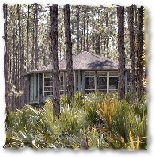
The wildland/urban interface (WUI) is "The line, area or zone where structures and other human development meet or intermingle with undeveloped wildland or vegetative fuels." In simpler terms, wildland/urban interface areas are locations where human structures and forests or wildlands meet or intermingle. Some examples are:
- Where the edge of a community transitions to forest land
- Individual farms or vacation homes surrounded by woodlands
- Homes around the edge of a (wooded) city park or preserve
People build homes in the wildland/urban interface for a number of reasons: to enjoy the beauty and solitude of natural surroundings, to escape the stress of city life and to live "close to nature." This creates unique challenges because interface residents frequently expect local government to provide the same level of service they received when they lived in the city (law enforcement, ambulance, fire protection, etc.). In addition, land managers find it increasingly difficult to manage forests for timber, wildlife and watershed when these areas are interspersed with subdivisions and individual homes.
Interface homes are frequently vulnerable to wildland fires because fire departments are no longer just minutes away, and are, for the most part, unable to protect homes in outlying areas from wildland fire disasters. This gained national attention in 1985, when over 1,400 homes were lost nationwide as a result of wildland fire (mostly in California and Florida). The following year, representatives from the U.S. Forest Service, National Association of State Foresters, National Fire Protection Association, U.S. Department of the Interior, and a number of other agencies and organizations met to discuss this growing problem. One result was the Firewise USA program. The Firewise USA program is a national initiative promoting community action and homeowner responsibility as the only effective way to solve this growing problem.
The Firewise USA program is based on two main principles:
- Homeowners must take some responsibility for home fire safety and become "partners" with the fire protection agencies, and
- Homes (neighborhoods and communities) can be designed, built and maintained to withstand a wildland fire without the intervention of a fire department.
Today we are still learning how to live safely in Florida's fire-prone environment. Our growing population continues to move from our towns and cities and build in areas that have historically been forest or wildland. This expansion into the wildland/urban interface has resulted in an increased number of homes threatened by wildfire. We must become "Firewise" by learning how to protect our families, our homes and our property from wildfire.
Help Prevent Wildfire in Your Community
Our Wildfire Mitigation Specialists present Firewise workshops and other information about how you can lower your wildfire risk and help prevent wildfires. Contact the Wildfire Mitigation Specialist in your area.