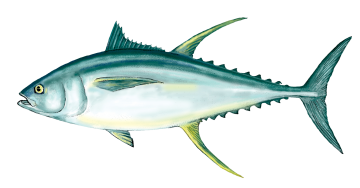
Delicious and nutritious, yellowfin tuna (Thunnus albacares) is one of the world’s most important food fish. It lives in pelagic (open ocean) waters off both of Florida’s coasts and is a staple in seafood markets and restaurants around the state. Though yellowfin tuna is available year round, June, July, and August are the months of peak supply.
Yellowfin tuna is a beautiful fish, with a dark metallic blue body, a silver belly, and bright yellow fins. Its torpedo-shaped body is built for speed. It has to swim fast to catch its prey — smaller fish, squid, and shrimp — and to avoid becoming prey to certain species of whales and sharks. Yellowfin tuna is one of the largest species of tuna. Individuals have been known to weigh up to 400 pounds, but commercial catches tend to be much smaller, usually between 20 and 100 pounds.
Yellowfin tuna is a schooling fish and often travels in the company of other tuna species of similar size. Schools of yellowfin tuna are known to gather around masses of floating debris or near groups of dolphins. Because of yellowfin tuna’s association with dolphins, special care must be exercised in the tuna’s harvest. In Florida, yellowfin tuna are caught with hook and line, one at a time, never with nets, so they are guaranteed “dolphin safe.”
Fresh yellowfin tuna doesn’t look or taste like the tuna you buy in a can. It’s deep red in color with a sweet, mild flavor and a dense, firm, beef-like texture. Fresh yellowfin tuna is typically sold in loin form.
When shopping for fresh tuna, look for firm meat with a fresh sea-breeze aroma and no discoloration. Store fresh tuna in the coldest part of the refrigerator at 32 degrees Fahrenheit for up to two days. To freeze, wrap fish tightly to prevent freezer burn. Date the package and store at 0 degrees Fahrenheit for up to two months. Thaw in the refrigerator or under cold running water.
Tuna is traditionally cooked to rare or medium-rare in the center. For a rare center, cook two minutes on each side; for a medium center, cook three to five minutes; and for a well-done center, cook five to eight minutes. As tuna cooks, it turns from pink or red to tan or ivory white.
Versatile yellowfin tuna tastes great raw, grilled, baked, broiled, blackened, pan seared, or smoked. Yellowfin tuna is widely used in sashimi, Japanese dishes featuring fresh raw fish sliced thin and served with a dipping sauce.
Attributes
Firm, light meat with full flavor. Lean fish.
Substitutes
Swordfish, mahi-mahi, king mackerel.
How Much to Buy
Whole or drawn fish: 3/4 to 1 pound per serving.
Dressed or cleaned fish: 1/2 pound per serving.
Fillets or steaks: 1/4 to 1/3 pound per serving.
Buying, Storage and Handling
Remember to purchase seafood last and keep it cold during the trip home.
Fresh whole fish should have:
- A shiny surface with tightly adhering scales.
- Gills that are deep red or pink and are free of slime, mucus and off-odor.
- Clean shiny belly cavity with no cuts or protruding bones.
- A mild aroma, similar to the ocean.
Fresh steaks, fillets and loins should have:
- A translucent look.
- Flesh that is firm and not separating.
- A mild odor, similar to the ocean.
- No discoloration.
- Packaging that keeps them from being bent in an unnatural position.
Preparation
Keep raw and cooked seafood separate to prevent bacterial cross-contamination.
After handling raw seafood, thoroughly wash knives, cutting surfaces, sponges and your hands with hot soapy water.
Always marinate seafood in the refrigerator.
Discard marinade; it contains raw juices, which may harbor bacteria.
When marinade is needed for basting, reserve a portion before adding raw seafood.
Cooking
The yellowfin tuna's light and mild-flavored meat can be cooked in a variety of ways: smoked, grilled, blackened, baked, broiled or sauteed; overcooking reduces moisture and flavor.
The general rule is 10 minutes per inch of thickness, at the thickest part of the fillet or steak, at 400-450 degrees F.
If fish is cooked in parchment, foil or a sauce, add 5 minutes to the total cooking time.
Fillets less than 1/2 inch thick do not need to be turned during cooking.
Fish cooks quickly. Do not overcook.
Fish is done when the flesh becomes opaque and flakes easily when tested with a fork.
Poaching, steaming, baking, broiling, sauteing and microwaving are excellent low-fat cooking methods, if you do not add high-fat ingredients.
Marinate in your favorite salad dressing prior to cooking.
Broil, bake, steam or microwave, then cube and add to pasta or salad greens for a delicious salad.
Broil or grill with lime-butter and seasoned salt.
Oil the grill to prevent fish from sticking.
Bake whole fish with a crab or shrimp stuffing.
Add leftover fish in broken pieces to salads, soups or sauces.
Nutrition
Nutritional values for approximately 4 ounces (114 grams) of raw, edible portions:
- Calories: 130
- Calories From Fat: 20
- Total Fat: 2g
- Saturated Fat: 0.5g
- Cholesterol: 50mg
- Sodium: 70mg
- Total Carbohydrates: 0g
- Protein: 26g
- Vitamin A: 0%DV
- Vitamin C: 0%DV
- Calcium: 0%DV
- Iron: 4%DV
- Omega-3 Fatty Acid: 0.23g