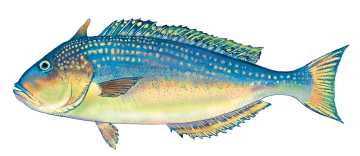
Tilefish are members of the family Malacanthidae, which is a group of fish that is widespread in tropical and temperate waters.
Six different types occur along the Atlantic coast of the United States. Two of those types, the golden tilefish (Lopholatilus chamaeleonticeps) and the blueline or gray tilefish (Caulolatilus microps), are fairly plentiful in Florida waters. The golden tilefish is the most colorful fish with a blue-green back that fades to a pearly white belly. It is touched with red and blue iridescence, highlighted by irregular yellow-gold spots and ocean-blue under the eyes. Combined with these colorful markings is the adipose flag or crest on the head. The blueline tilefish is similar in taste to the golden tilefish, but it is not as colorful and lacks the adipose flag.
Along the southeastern coast and in the Gulf, tilefish live in burrows and sometimes congregate in pods or small groups at depths ranging from 200 to more than 1,400 feet. As tilefish become larger they tend to live at greater depths. Tilefish do not school, but group in clusters near the heads and sides of submarine canyons along the outer continental shelf. The predominant fishing method is longlining with the greatest catch taken during the daylight hours. Adults weigh an average of 10-25 pounds.
Attributes
Firm, white meat with mild flavor. Extra lean fish.
Substitutes
Amberjack, tilapia, grouper, shark, snapper.
How Much to Buy
Whole or drawn fish: 3/4 to 1 pound per serving.
Dressed or cleaned fish: 1/2 pound per serving.
Fillets or steaks: 1/4 to 1/3 pound per serving.
Buying, Storage and Handling
Remember to purchase seafood last and keep it cold during the trip home.
Fresh whole fish should have:
- A shiny surface with tightly adhering scales.
- Gills that are deep red or pink and are free of slime, mucus and off-odor.
- Clean shiny belly cavity with no cuts or protruding bones.
- A mild aroma, similar to the ocean.
Fresh steaks, fillets and loins should have:
- A translucent look.
- Flesh that is firm and not separating.
- A mild odor, similar to the ocean.
- No discoloration.
- Packaging that keeps them from being bent in an unnatural position.
Preparation
Keep raw and cooked seafood separate to prevent bacterial cross-contamination.
After handling raw seafood, thoroughly wash knives, cutting surfaces, sponges and your hands with hot soapy water.
Always marinate seafood in the refrigerator.
Discard marinade; it contains raw juices that may harbor bacteria.
When marinade is needed for basting, reserve a portion before adding raw seafood.
Cooking
The general rule is 10 minutes per inch of thickness, at the thickest part of the fillet or steak, at 400-450 degrees F.
If fish is cooked in parchment, foil or a sauce, add 5 minutes to the total cooking time.
Fillets less than 1/2 inch thick do not need to be turned during cooking.
Fish cooks quickly. Do not overcook.
Fish is done when the flesh becomes opaque and flakes easily when tested with a fork.
Poaching, steaming, baking, broiling, sautéing and microwaving are excellent low-fat cooking methods, if you do not add high-fat ingredients.
Marinate in your favorite salad dressing prior to cooking.
Broil, bake, steam or microwave, then cube and add to pasta or salad greens for a delicious salad.
Broil or grill with lime-butter and seasoned salt.
Oil the grill to prevent fish from sticking.
Bake whole fish with a crab or shrimp stuffing.
Add leftover fish in broken pieces to salads, soups or sauces.
Nutrition
Nutritional values for approximately 4 ounces (114 grams) of raw, edible portions:
- Calories: 110
- Calories From Fat: 15
- Total Fat: 2g
- Saturated Fat: 0g
- Cholesterol: 55mg
- Sodium: 75mg
- Total Carbohydrates: 0g
- Protein: 22g
- Vitamin A: 0%DV
- Vitamin C: 0%DV
- Calcium: 2%DV
- Iron: 2%DV
- Omega-3 Fatty Acid: 0.43g
Mercury Advisory
For women of child-bearing age and small children, there are health hazards associated with mercury in swordfish. For additional information, visit the U.S. Food and Drug Administration website.