Florida stone crab season opens October 15 and runs through May 1. The fishery is closed for five months each year to help protect and sustain Florida’s valuable stone crab resource.
Stone crab, Menippa adina and Menippa mercenaria and their hybrids, inhabit bays and estuaries along the Atlantic and Gulf coasts. They hide under rock and shell fragments in shallow water, and when they’re fully grown they dig slanting burrows 12 to 20 inches deep.
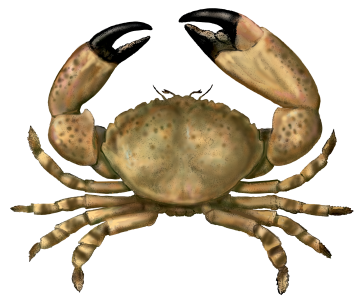
An adult stone crab is easily recognized by its oval-shaped body and two large claws. The body is dark brownish red with dusky gray spots. The large claws have shiny black tips and are used by the crab for hunting and for defending itself. A crab can intentionally drop a claw if the claw is damaged or if the crab is trying to escape from a predator. The claw will eventually grow back, getting larger each time the crab molts.
The stone crab’s ability to regenerate lost limbs makes it possible to harvest the meaty claws without killing the crab. Florida law forbids the harvesting of whole stone crabs. Instead, fishermen remove one or both claws and return the live crab to the water, where it can regenerate its lost limbs in about 18 months. Claws must be at least 2-3/4 inches long to be harvested legally, and claws may not be taken from egg-bearing females. Claws must be removed carefully, at just the right spot, in order for regeneration to take place.
Stone crabs are caught using baited traps. Though stone crabs can be found as far north as North Carolina and as far west as Texas, stone crab claws are commercially harvested almost entirely in Florida. The majority are harvested off the southern tip of the peninsula from Sarasota to Fort Lauderdale. Stone crab is one of Florida’s top commercial seafood products in terms of dockside value.
Stone crab claws are cooked in boiling water immediately after harvest, on the boat or at dockside, to prevent the meat from sticking to the inside of the shell. Claws are sold fresh-cooked or frozen. They come in several size grades based on weight: medium (up to 3 ounces), large (between 3 and 5 ounces), and jumbo (5 ounces and up). It generally takes about a pound of crab claws to feed one person.
Stone crab claws are usually served in the shell. One of the most popular ways to serve them is cold on a bed of ice with a mustard dipping sauce, but they are also commonly eaten hot with drawn butter and lime juice. The firm, sweet meat tastes similar to lobster. It’s extra lean, low in fat, and a good source of protein.
Fresh-cooked stone crab claws should have a mild sea-breeze aroma. Store them at 32 degrees Fahrenheit in the coldest part of the refrigerator and be sure to use them within two days of purchase. Stone crab claws without cracks in the shell can be frozen for up to six months. Thaw frozen claws in the refrigerator for 12 to 18 hours. Thawing them in running water or at room temperature will negatively affect the taste and texture.
To crack the shell, use a crab cracker (a tool available at kitchen supply shops and department stores) or the back of a heavy spoon. Remove the cracked shell pieces, leaving the meat attached to the moveable pincer. The meat can also be picked from the claws and used in soups, stews and other dishes. Approximately 2 1/2 pounds of cooked stone crab claws yield 1 pound of meat.
Attributes
Firm texture, sweet meat. Low fat. Extra lean.
Substitutes
Golden crab, blue crab.
How Much to Buy
Stone crab claws: 3 claws per serving.
Buying, Storage and Handling
Remember to purchase seafood last and keep it cold during the trip home.
Stone crab claws are available cooked. Claws are immersed in ice water after harvest, cooked immediately, then immersed in ice water again to prevent the meat from sticking to the inside of the shell.
Store cooked crabs and picked meat in the coldest part of your refrigerator or "meat keeper" at 32 degrees F and use within two days.
Stone crab claws that are completely intact (occasionally claws crack during handling) can be frozen at 0 degrees F for up to six months.
Thaw frozen stone crab claws in the refrigerator for 12 to 18 hours. If thawed under running water, quality will be lost.
Preparation
Keep raw and cooked seafood separate to prevent bacterial cross-contamination.
After handling raw seafood, thoroughly wash knives, cutting surfaces, sponges and your hands with hot soapy water.
Always marinate seafood in the refrigerator.
Discard marinade; it contains raw juices, which may harbor bacteria.
When marinade is needed for basting, reserve a portion before adding raw seafood.
Cooking
To remove meat from shell, crack all sections of shell with a hammer or nut cracker and pick out the meat.
Serve alone or use in any recipe calling for crabmeat or lobster.
To serve as hors d'oeuvre or appetizer, remove the shell and movable pincer; leave the meat attached to the remaining pincer. Serve with drawn butter and fresh lime juice.
Nutrition
Nutritional values for approximately 4 ounces (114 grams) of raw, edible portions:
- Calories: 60
- Calories From Fat: 0
- Total Fat: 0g
- Saturated Fat: 0g
- Cholesterol: 45mg
- Sodium: 300mg
- Total Carbohydrates: 0g
- Protein: 15g
- Vitamin A: 0%DV
- Vitamin C: 0%DV
- Calcium: 8%DV
- Iron: 2%DV
- Omega-3 Fatty Acid: 0g