Florida hard clams are harvested year round and are always available in steady supply. Though some clams are still wild caught, clam farming is a growing industry.
Clam farmers lease coastal water bottoms from the state, through the Florida Department of Agriculture and Consumer Services, which also monitors and manages water for shellfish harvesting. Submerged lands are generally leased in 2- to 5-acre parcels. Clam farmers plant pea-sized seed clams on the ocean bottom under nets or in mesh bags to protect them from predators (blue crabs, stone crabs and other animals). In Florida’s warm waters, clams grow quickly. Farmers monitor the clams for 12 to 18 months until they reach market size.
Wild hard clam fishermen and some farmers use a “jerk rake” to harvest clams. A rake-like head on the end of an elongated steel pole is manually dragged or jerked across the bottom to pull the clams up and out of the sediments. The clams are then graded and marketed by the depth of the shell at the hinge side, or they are shucked and the meats canned.
Clams can’t tolerate bacteriological or industrial pollution, so successful clam farming requires excellent water quality. And clam farming itself actually improves water quality — because clams are filter feeders and continually remove algae and nutrients from the water.
Clam farmers don’t use chemicals, antibiotics, feeds or other inputs, so clam farming is a clean industry. And as an added benefit, mesh clam bags even act as artificial reefs, providing habitat for billions of marine organisms.
Clam farming has little negative impact on the environment but plenty of positive impact on local economies. The industry provides hundreds of jobs for residents of coastal communities. Secondary industries, such as the construction of aquaculture nurseries and the manufacture of clamming equipment, spring up in the wake of new clam farms.
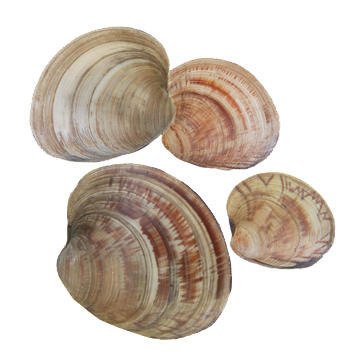
The hard clam is a brown, nearly oval-shaped bivalve mollusk with a thick, hard shell that protects the meat. The shell can grow to a width of 4 1/2 inches and is marked by rings or ridges that indicate the clam’s growth and age, which can be more than 30 years. There are two commercially important varieties of hard clams harvested in Florida: the northern quahog (Mercenaria mercenaria) and the southern quahog (Mercenaria campechiensis).
The most prominent features of the hard clam’s body are the foot and the neck, or siphon. The foot allows the clam to bury itself in soft sand or mud. The tube-like neck pumps sea water, up to 3 gallons an hour, in and out of the clam. During this process the hard clam filters out and feeds on plankton and other microscopic organisms.
When shopping for live clams, make sure the shells are free of cracks. Your nose will tell you if the clams are fresh. Live clams should have a mild sea-breeze aroma.
Clams should never be exposed to sudden temperature change. When storing live clams, do not place them directly on ice or immerse them in water. Store live clams at a constant 41 degrees F in the refrigerator in a container with the lid slightly open. They will remain alive for up to seven days. Drain excess liquid daily. Live clams should close tightly when the shell is tapped. Discard clams that do not close. Shucked clams will keep for up to seven days in the refrigerator.
Before cooking, rinse live clams thoroughly under running water. Clams are thoroughly cooked when their shells open and the meat turns plump and opaque. Lean, firm-textured clams are low in fat, cholesterol and sodium. They provide calcium and iron and are an excellent source of protein.
Attributes
Firm texture, rich meat with sweet to slightly salty flavor. Extra lean.
Substitutes
Scallops, oysters.
How Much to Buy
In-shell clams: 6 whole clams per serving.
Shucked clams: 1/2 pint per serving.
Buying, Storage and Handling
Live Clams
Remember to purchase seafood last and keep it cold during the trip home.
Live clams should close tightly when tapped.
Discard any clams that don't close; this is an indication that the shellfish are dead.
They should have a mild odor, similar to the ocean.
Live clams should be free of cracks.
Middleneck, littleneck and pasta are names related to the size of the clam.
Clams will remain alive for up to seven days in the refrigerator when stored at a constant 41 degrees F in a container with the lid slightly open.
Drain excess liquid daily.
Clams should never be placed directly on ice.
Clams should never be immersed in water for storage purposes.
Clams should never be exposed to sudden temperature change.
Shucked Clams
Remember to purchase seafood last and keep it cold during the trip home.
Clams have a fresh odor when freshly shucked.
Refrigerate shellfish in a sealed container on ice or in the coldest part of the refrigerator.
Store shucked clams up to seven days.
Preparation
Keep raw and cooked seafood separate to prevent bacterial cross-contamination.
After handling raw seafood, thoroughly wash knives, cutting surfaces, sponges and your hands with hot soapy water.
Always marinate seafood in the refrigerator.
Discard marinade; it contains raw juices that may harbor bacteria.
When marinade is needed for basting, reserve a portion before adding raw seafood.
Cooking
Wash live clams thoroughly under cold running water prior to cooking.
To grill: Place about 4 inches from hot coals. Grill for approximately 10 minutes or until clams open.
To roast in oven: Place on a baking sheet on the middle rack. Roast at 350 degrees F for approximately 10 minutes or until clams open.
Serve roasted and grilled clams in shells with melted butter or a sauce.
Clams become plump and opaque when thoroughly cooked.
Clam Sizes
Number per pound and hinge size are approximate:
| Type | Amount | Size |
|---|---|---|
| Cherrystone | 3-4 per pound | 2-inch hinge |
| Topneck | 5-7 per pound | 1 1/2-inch hinge |
| Middleneck | 7-9 per pound | 1 1/4-inch hinge |
| Littleneck | 10-13 per pound | 1-inch hinge |
| 7/8 Inch | 14-18 per pound | 7/8-inch hinge |
| Pasta | 18-25 per pound | 3/4-inch hinge |
Nutrition
Nutritional values for approximately 4 ounces (114 grams) of raw, edible portions:
- Calories: 50
- Calories From Fat: 10
- Total Fat: 1g
- Saturated Fat: 0g
- Cholesterol: 45mg
- Sodium: 65mg
- Total Carbohydrates: 3g
- Protein: 10g
- Vitamin A: 0%DV
- Vitamin C: 0%DV
- Calcium: 8%DV
- Iron: 20%DV
- Omega-3 Fatty Acid: 0.15g