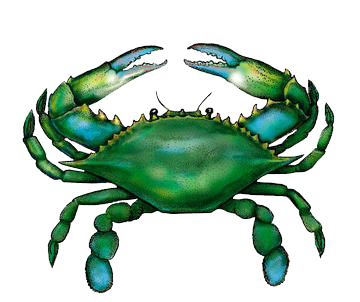
Blue crabs are commercially harvested with baited traps along the Atlantic and Gulf coasts in bays, sounds, channels and river mouths. The bulk of the harvest comes from Wakulla, Citrus and Duval counties. Blue crab is one of Florida’s top 10 seafood products in dockside value and ranks in the top five in terms of pounds harvested.
The blue crab (Callinectes sapidus) has a dark green or olive green hard shell and five pairs of bright blue legs. The undersides of the body and legs are white. Only the first pair of legs is equipped with pincers or claws. Male and female claws are various shades of blue on the top, but the tips of the female’s claws are bright red.
Blue crab is harvested and eaten in two stages of its life cycle, when the exoskeleton is hard and also when it’s soft. The soft-shell blue crab is a hard-shell crab that has shed its shell by molting. “Peeler” crabs (crabs in the process of molting) are held in water-filled tanks and watched closely until they form their soft shells and shed their hard ones. Then they are plucked out of the tanks and rushed to market. Soft-shell crabs are considered a delicacy and can be eaten shell and all.
Hard-shell crabs are sold live or steamed to restaurants and seafood markets. They are also sold to picking houses, where the delicate meat is extracted from the shell, usually by hand. Picked crab meat is available fresh or pasteurized.
Live blue crabs should have some leg movement when purchased. Store them in a moist environment at 50 degrees Fahrenheit in a bag, cardboard box or other breathable container. Do not store them directly on ice. Fresh blue crab meat should be stored on ice in the coldest part of the refrigerator and used within seven to 10 days. Pasteurized blue crab meat in unopened containers can be stored up to six months in the coldest part of the refrigerator. Once opened, pasteurized crab meat needs to be used within three days.
Sweet, creamy blue crab is high in protein and low in fat. It contains calcium, iron and vitamins as well as omega-3 fatty acids, which contribute to heart health.
Attributes
Delicate texture, sweet meat, low fat.
Substitutes
Stone crab, golden crab, spiny lobster, shrimp.
How Much to Buy
Blue crab, in shell: 3 to 4 whole crabs per serving.
Blue crab, meat: 1/6 pound per serving.
Buying, Storage and Handling
Live Crabs
Remember to purchase seafood last and keep it cold during the trip home.
Blue crabs should have some leg movement when purchased.
Discard dead crabs and ones with broken shells.
Refrigerate in a breathable container (a bag or cardboard box).
Do not store directly on ice.
Meat
Remember to purchase seafood last and keep it cold during the trip home.
Blue Crab is available fresh and pasteurized in the following forms: lump, backfin, special, claw and cocktail claw.
Pasteurized blue crab meat in unopened containers can be stored up to six months in the coldest part of your refrigerator.
Once opened, use within three days.
Fresh Blue Crab meat should be stored on ice in the coldest part of your refrigerator and used within seven to 10 days.
Soft-Shell Blue Crab
Remember to purchase seafood last and keep it cold during the trip home.
Soft-shell blue crab is available live, fresh or frozen.
Fresh soft-shell blue crab should be refrigerated and cooked within two days.
Preparation
Keep raw and cooked seafood separate to prevent bacterial cross-contamination.
After handling raw seafood, thoroughly wash knives, cutting surfaces, sponges and your hands with hot soapy water.
Always marinate seafood in the refrigerator.
Discard marinade; it contains raw juices, which may harbor bacteria.
When marinade is needed for basting, reserve a portion before adding raw seafood.
Cooking
To cook: Add to boiling seasoned water and simmer for 12 to 15 minutes.
Cooked meat: Toss with salad greens, use as a topping on pizza, make crab cakes or use in dips and spreads.
Nutrition
Nutritional values for approximately 4 ounces (114 grams) of raw, edible portions:
- Calories: 90
- Calories From Fat: 10
- Total Fat: 1g
- Saturated Fat: 0g
- Cholesterol: 80mg
- Sodium: 320mg
- Total Carbohydrates: 0g
- Protein: 19g
- Vitamin A: 0%DV
- Vitamin C: 0%DV
- Calcium: 10%DV
- Iron: 6%DV
- Omega-3 Fatty Acid: 0.32g