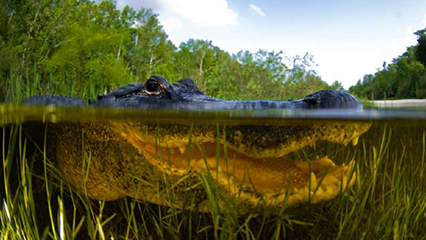
Learn about Florida's alligator products, including alligator meat, finished leather products and more.
The American alligator ( Alligator mississippiensis) is a species of great ecological importance. It’s also a source for nutritious meat and durable, high-quality leather. Thanks to strict conservation and management programs, Florida’s alligator population has exploded in recent decades. Consumers can support alligator conservation programs by buying genuine alligator products.
Alligators were removed from the endangered species list in 1987, and the number of wild alligators inhabiting Florida’s lakes, rivers, swamps and marshes now tops 1 million. Marsh management programs help monitor the wild alligator population and reduce poaching. These highly effective programs are funded by sales of alligator products and licensing fees paid by alligator farmers, hunters and trappers.
The American alligator is often referred to as a “keystone species” because it plays such an important role in its ecosystem. The alligator is an apex predator (an animal at the top of its food chain) and helps keep populations of prey species in check. During dry periods, alligator holes and alligator trails typically retain water and serve as refuges for turtles, birds, fish and other animals, helping them survive until the rains return. Large, mound-like alligator nests, made of mud and torn-up vegetation, serve as nesting spots for Florida red-bellied turtles. Over time, alligator nests decompose to create peat. Peat is very important because it stores carbon and provides habitat for specialized plants and animals.
Young alligators are dark-colored and marked with bands of yellow for camouflage. The yellow bands fade as the alligator matures. Adult males range in length from 11 to 15 feet and can weigh more than 1,000 pounds. Adult females usually measure 8 to 10 feet. Alligators can live 30 to 40 years in the wild, and longer in captivity.
Alligator farming helps take pressure off the wild alligator population while meeting demand for alligator products. Some alligator farms maintain adult breeding stock that produce all the eggs needed for the farming operation. Other farms rely on eggs collected from the wild under permit from the Florida Fish and Wildlife Conservation Commission. Whether produced on the farm or collected in the wild, the eggs are hatched in incubators. Hatchlings are raised on the farm in heated indoor pens. Under controlled environmental conditions, alligators grow quickly, reaching maturity in two years or less.
Alligator is a lean meat that is low in fat and cholesterol and high in protein. It is available in a variety of cuts, including tail meat fillets, ribs, nuggets and wings. Tail meat, the choicest cut, is a mild-flavored white meat that has a texture similar to veal. Ribs, nuggets, and wings are darker meat with a stronger taste and a texture similar to pork shoulder. Alligator meat is versatile and can be used in just about any recipe as a substitute for chicken, pork, veal, or fish.
Alligator meat is usually purchased frozen, but it is also available fresh. Thaw frozen meat in the refrigerator and use promptly. Use a meat mallet to tenderize fillets and flatten the meat to your desired thickness. Alligator meat can be ground or finely chopped to make sausage, patties, or taco filling. Alligator’s mild flavor is easily enhanced with seasonings, sauces, and marinades.
Alligator leather is particularly durable and can last a lifetime with proper care. Because each alligator hide has a unique pattern of “tiles” (or scales), each item made from alligator leather is special, and this uniqueness is another reason that alligator-leather products are highly regarded and much sought after.
The white meat has a fine, light-grained texture that many people compare favorably to pork and chicken.
Frozen: Alligator is usually purchased frozen. Alligator meat is sold frozen as a bone-in, deboned, or deboned and tenderized product. Handle the meat as you would any other frozen product; mark the package with the date you purchased it and make sure it is tightly wrapped to prevent freezer burn. Thaw the meat in the refrigerator and use promptly. Do not re-freeze once thawed.
Fresh: Remove all excess fat on the outside of the cut and between the meat layers. For extra tenderness, use a meat mallet or a cuber and then cut across the grain of the meat to yield meal-sized portions. For freezer storage, wrap tightly with cellophane and freezer paper to prevent freezer burn for up to four months.
Keep raw and cooked alligator meat separate to prevent bacterial cross-contamination.
After handling raw alligator meat, thoroughly wash knives, cutting surfaces, sponges and your hands with hot soapy water.
Always marinate alligator meat in the refrigerator.
Discard marinade; it contains raw juices, which may harbor bacteria.
When marinade is needed for basting, reserve a portion before adding raw alligator meat.
Alligator has its own unique flavor that is easily enhanced with seasonings and sauces. Many of your favorite recipes for veal, chicken and seafood can be successfully prepared with alligator.
Nutritional values for approximately 3.2 ounces (100 grams) of raw, edible portions:
The grid below lists suppliers of alligator products. Contact each supplier directly for information regarding days and hours of operation, products, tours or other services.
| Company Name | City | Phone | Product Type |
|---|---|---|---|
| All American Gator Products | Hallandale | (954) 894-8003 | Meat, Hides, Leather |
| Alligator Bob's Gourmet Alligator | Thonotosassa | (813) 986-3008 | Meat |
| Alligator Inc. | Clewiston | (239) 564-0342 | Meat, Hides |
| Alligator Leather Buy Kinnamon | Lakeland | (863) 858-6971 | Leather |
| Alligator Management | Lakeland | (863) 640-7783 | Hides |
| Alligator Trading Company Inc. | Dade City | (352) 279-2676 | Hides, Leather |
| Boston's Gator Farm | Lake Monroe | (407) 322-9238 | Meat, Hides |
| Brooks Brothers Farm | Christmas | (407) 568-0134 | Meat, Hides |
| C&H Gators | Pierson | (386) 566-1317 | Meat |
| Casa del Rio Collection LLC | Fort Pierce | (772) 595-2196 | Leather |
| Central Florida Trophy Hunts | Cocoa | (321) 632-8995 | Meat, Hides, Leather |
| Chloe's Gator Processing | Deland | (386) 804-6758 | Meat |
| Classic Alligator Products | Palmetto | (941) 722-2727 | Leather |
| Cypress Creek Farms | Stark | (904) 964-3339 | Meat, Hides |
| Fagan's Alligator Products | Dade City | (352) 279-2676 | Meat, Leather |
| Gator Guides | Tampa | (813) 220-6854 | Hides, Leather |
| Gatorland Inc. | Orlando | 1-800-393-5297 | Hides, Leather |
| Gatorama | Palmdale | (863) 675-0623 | Meat, Hides, Leather |
| Gators R Us | Dade City | (941) 232-3313 | Meat |
| Giorgio's of Palm Beach | Palm Beach | (561) 655-2446 | Leather |
| Glass Enterprises Inc. | Camilla, Georgia | (229) 336-9325 | Meat, Hides, Leather |
| Kent's Fur and Seafood | Port St. Joe | (850) 229-6682 | Meat |
| Luxury Leather | Clermont | (407) 656-3723 | Hides, Leather |
| M&D Gator Products Inc. | Dade City | (352) 583-2786 | Meat |
| Parker Island Processing | Lake Placid | (863) 465-3161 | Meat, Hides, Leather |
| Parlier Processing | Clermont | (407) 656-3723 | Meat |
| Quality Seafood | Lakeland | (863) 858-6971 | Leather |
| Sultan Fine Leathers | Hollywood | 1-877-978-5826 x 101 | Leather |
| Vaughan Gators LLC | Tallahassee | (850) 545-7661 | Meat, Hides |