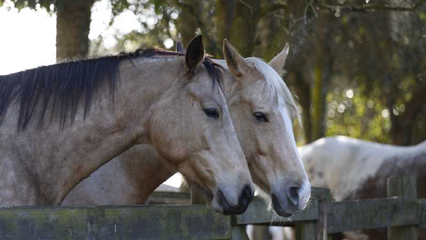
Equine piroplasmosis is a blood-borne disease of horses, donkeys and mules caused by one of two protozoan parasites.
Equine piroplasmosis is a blood-borne disease of equids (horses, donkeys, mules and zebras) caused by one of two protozoan parasites, Theileria equi or Babesia caballi. The United States is considered "free" of this disease. Positive cases must be reported to state or federal animal health officials.
Natural transmission occurs when a tick consumes a blood meal from an infected horse and transfers the parasite to a naïve horse or to subsequent generations of ticks.
Species of ticks capable of transmitting the causative organisms are naturally found in the United States but are not known to exist in Florida at this time.
Additionally, an infected pregnant mare may pass the organism to her foal in utero, but this is uncommon.
Iatrogenic transmission via the use of infected blood or blood products, or by the use of blood-contaminated equipment such as needles, syringes, surgical instruments, dental equipment, tattooing equipment, or any other equipment may spread the disease to a naïve horse.
After an incubation period of five to 28 days, clinical signs may include fever, anemia, yellowing of the mucous membranes (jaundice), dark brown or red-tinged urine, collapse and death in severe cases.
Horses that survive the clinical phase of the disease continue to carry the parasite in their red blood cells. These persistently infected horses pose a risk for infection to other horses.
Stress, such as racing, heavy exercise, or transport, may increase the levels of parasite present in the blood of the infected horse, thereby increasing the risk of disease spread.
Equine piroplasmosis is diagnosed by a serologic test. In the United States, testing is performed by a complement fixation (CF) and enzyme-linked immunodiffusion antibody (ELISA) test for both causative organisms.
Tests are used in parallel, as CF more readily detects acute disease while ELISA is more sensitive for detecting chronic infection.
A treatment has been recently developed to treat Theileria equi infections.
Positive horses can be enrolled in a state-federal approved treatment program. Treatment with an anti-prozoal drug, Imidocarb, is performed at the owner’s expense and by a USDA-accredited veterinarian under the observation of a state or federal animal health official.
The horse is quarantined for the entire length of treatment.
Equine piroplasmosis is a blood-borne disease. To protect horses from this disease:
Positive tests are reported by the testing laboratory to the local, state or federal animal health official.
The positive horse will be placed under quarantine by a Florida Department of Agriculture and Consumer Services (FDACS) Animal Health Official.
Options for a test-positive horse are enrollment into the United States Department of Agriculture Animal and Plant Health Inspection Service (USDA APHIS) equine piroplasmosis treatment program, lifetime quarantine or euthanasia.
All exposed horses will also be tested for the disease. An exposed horse is any horse that:
Exposed horses will be placed under quarantine and retested for the disease after 45 to 60 days. If found negative at that time, the quarantine will be released.
Suspected or confirmed cases of equine piroplasmosis must be reported to the State Veterinarian’s Office. To report equine piroplasmosis or other reportable diseases, call (850) 410-0900 from 8 a.m. to 5 p.m., Monday through Friday. For after-hours reporting, call 1-800-342-5869 or email RAD@FDACS.gov.