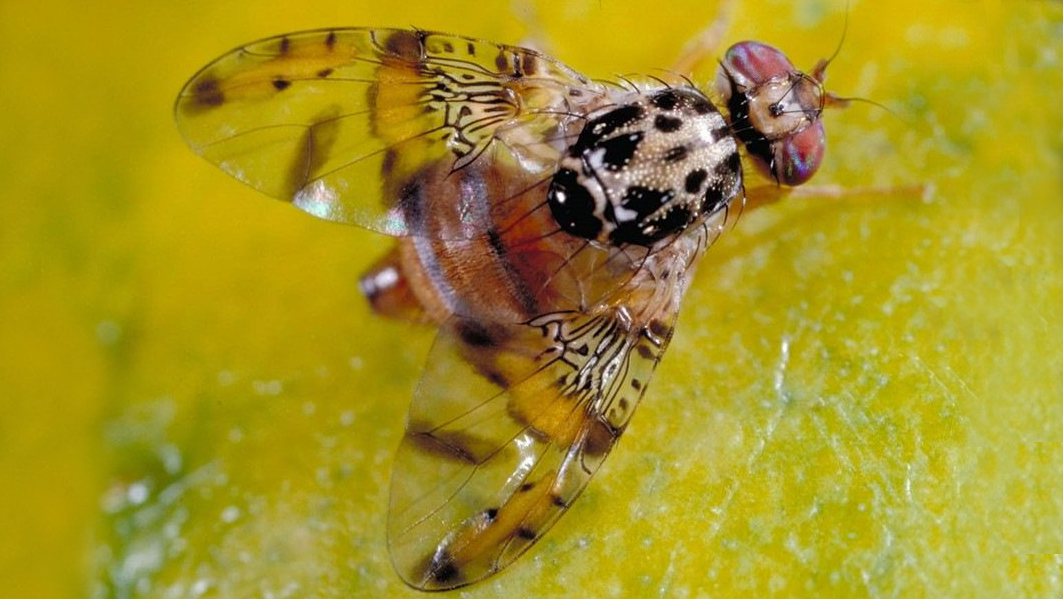
Exotic fruit flies, such as the Oriental fruit fly and Mediterranean fruit fly, are a major threat to U.S. agriculture, threatening production and control losses in the millions of dollars. Their impact to U.S. agriculture in the last 50 years totals $509 billion. Florida’s subtropical climate, its 29 air and maritime ports of entry, a highly mobile and cosmopolitan human population, and an abundance of cultivated and indigenous hosts make the state extremely vulnerable to fruit fly infestation. Fruit flies can reproduce rapidly and infest over 400 species of fruits and vegetables of commercial importance (mango, oranges, guava, melon, pumpkin, etc.). If left uncontrolled, infestations can spread quickly; therefore, we must respond swiftly to eradicate any introductions as soon as possible.
The Florida Department of Agriculture and Consumer Services' (FDACS) Fruit Fly Methods Development Lab focuses on developing and testing new fruit fly detection and eradication technology, such as lures to increase detection and control capabilities, improve personnel safety, and enhance operational efficacy and ease of use in the field. In general, the lab’s research supports state and federal fruit fly detection and eradication programs, protecting the nation’s agricultural and natural resources. Present areas of emphasis include lures/attractants, bait stations and Male Annihilation Technique. We often work in conjunction with the U.S. Department of Agriculture's Animal and Plant Health Inspection Service (USDA APHIS) and Agricultural Research Service (USDA ARS) and our tri-state partners, the California Department of Food and Agriculture and the Hawaii Department of Agriculture.
Lures/Attractants
Detection of Mediterranean fruit fly relies on traps baited with trimedlure, a male-specific attractant. Trimedlure is dispensed from solid polymeric plugs that increase the field longevity of the lure. Traps with 4-gram plugs are re-baited at six-week intervals, but research is underway to determine if these plugs remain effective for longer intervals. Field studies consist of experiments evaluating the longevity and performance of the 4-gram plug, based on sterile released medfly capture rates. Subsequent lab studies will determine residual content of trimedlure in the plugs.
Scientists at the USDA ARS have developed and patented an alternative Mediterranean fruit fly lure (a single compound) referred to as nomedlure. This lure is reported to have advantages over the standard trimedlure, including greater environmental stability, cheaper manufacture, and uniform composition. The relative attraction of the two lures to male medflies has not been tested in a field setting in Florida. Studies will simulate field conditions and use ongoing regular releases of sterile male Mediterranean fruit flies in the preventative release program.
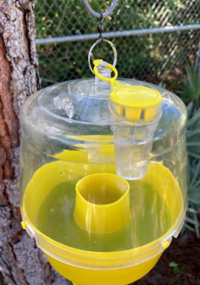
Fruit fly multilure trap
Fruit fly detection in Florida requires deployment of large numbers of traps individually baited with the highly attractive male-specific lures trimedlure (TML), methyl eugenol (ME) and cue-lure (CL), which is a synthetic analog of raspberry ketone (RK), to detect pests such as the Mediterranean fruit fly, Oriental fruit fly and melon fly, respectively. Two widely used traps are the Jackson trap and the multilure trap.
Early detection and timely control measures are critical to prevent the establishment of these destructive species. A recently developed solid TMR wafer with all three lures (TML, ME and RK) has the potential to significantly reduce the overall number of detection traps maintained on a continual basis throughout Florida. TMR-baited traps will provide more effective coverage and convenience because liquid lures and insecticides are not used.
Field studies from 2018-2019 evaluated the performance and longevity of the TMR wafer, weathered inside Jackson traps during summer (eight weeks) and winter (12 weeks) in three distinct areas of Florida, by analyzing captures of wild fruit flies in Hawaii. Additional studies comparing performance of TMR traps to the current program-standard TML traps will be performed using sterile medflies mass-reared as part of the preventative release program.
Bait Stations
Since 2010, USDA APHIS's Plant Protection and Quarantine Guatemala has been developing a wax-based bait station (Wax-BS). It has been in use since that time by the USA-Mexico-Guatemala Moscamed Regional Program as a cost-effective tool for Mediterranean fruit fly suppression. The bait station was also evaluated in Texas from 2014 to 2017 as a control option for Mexican fruit fly. The matrix consists of paraffin wax with a food coloring added to provide a visual stimulus, corn syrup and granulated sugar as feeding stimulants, and the toxicant Spinosad. The mixture is coated (via dipping) on a cardboard device that can be baited with a fruit fly-specific lure. The wax-based bait station is rainfast and remains attractive to target flies for a longer period than bait sprays.
During fruit fly emergency eradication programs, there are special situations where this bait station would be a preferred or only alternative (hotspots in protected areas, nature preserves, backyards, etc.) to aerial or foliar sprays. Although it has been tested and used extensively elsewhere, the bait station must be evaluated under specific conditions in Florida to determine how long it will remain effective. Testing is currently underway in Homestead targeting the Caribbean fruit fly.
Male Annihilation Technique
An invasive species of major concern is the Oriental fruit fly. Male Annihilation Technique (MAT) is a primary tactic to suppress or eradicate Oriental fruit fly. Current implementations of Male Annihilation Technique rely on the proprietary formulation known as “SPLAT-MAT-ME,” a combination of the male Oriental fruit fly attractant methyl eugenol (ME) and the toxicant Spinosad. This is a spot treatment applied in high densities to utility poles with the goal of attracting and eliminating high numbers of male flies. Recent field trials in Hawaii suggest that eradication programs would benefit by decreasing the application density, which results in improved efficacy, less product use, and, therefore, lower material and labor costs. Plans are underway for optimal Male Annihilation Technique density testing in urban settings in California, and later Florida, using sterile flies imported from Hawaii.
Tri-State Cooperative Fruit Fly Projects
FDACS scientists often participate in fruit fly projects with the California Department of Food and Agriculture, Hawaii Department of Agriculture, and USDA-APHIS and ARS based in these states. We share information and visit partner states to directly observe and assist with demonstration activities and field and laboratory studies. Hawaii has established populations of Mediterranean fruit fly, Oriental fruit fly and melon fly, three high-priority pests of concern to California, Florida and other states with amenable climate. With the aid of local scientists, we perform studies on fruit fly biology, behavior and host fruit preference; evaluate insecticides, lures and attractants; and determine the efficacy of suppression tactics. California has more recorded introductions of invasive fruit flies in recent years compared to Florida, and the FDACS has benefitted recently from technology transfer of equipment and materials used during emergency eradication programs.