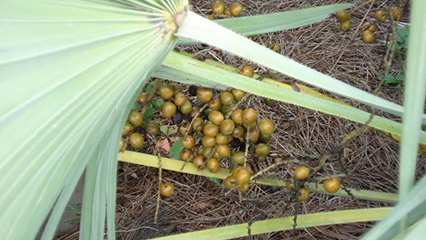
Some native Florida plants are protected under Chapter 5B-40, Florida Administrative Code. There are three categories of protected plants: threatened, endangered and commercially exploited. These plants are listed in Rule 5B-40.0055 — Regulated Plant Index.
Requirements for Harvesting Protected Plants
- Threatened Plants: Harvesting or collecting plants or parts of plants listed as threatened requires landowner permission.
- Endangered Plants: Harvesting or collecting one or more plants or parts of plants listed as endangered requires landowner permission and a permit issued by the Florida Department of Agriculture and Consumer Services (FDACS).
- Commercially Exploited Plants: Harvesting or collecting three or more plants or parts of plants listed as commercially exploited requires landowner permission and a permit issued by FDACS.
Before You Apply
The following resources will help you prepare so you can quickly and correctly apply for a permit.
-
Native, Endangered or Commercially Exploited (NECE) Plant Harvesting Permit Online Application FAQ
[
 195.9 kB
]
195.9 kB
]
-
Navigating the Online Portal
[
4.2 MB
]
How to Obtain a Permit
Submit Your Application Online
Alternatively, you can complete a Request for Permit to Harvest Endangered or Commercially Exploited Plant(s) or Plant Parts [ Adobe PDF Document ] and email or mail it to us.
- Email the completed application and permission letter(s) to DPINECE@FDACS.gov, or
- Send via mail to: Division of Plant Industry — Permit Unit, P.O. Box 147100, Gainesville, FL 32614-7100.
Please note: Paper applications may take upwards of two weeks to process depending on the number of applications received. Online submission will result in the fastest turnaround.
- Obtain signed permission from the landowner or property manager, including your
own property. - Include a brief description of the project for research or rescue purposes. Provide
an estimated timeline for the project. - For rescue purposes, description of the project must include expertise of harvesters
for plant care and final location for the rescued plants. - When applying for propagation or distribution of whole plants, provide a valid
nursery registration. - Indicate the requested plant parts: seed, fruit, flower, leaves, cuttings or stems
- Include the quantity of plants for harvest or indicate the amount in pounds (lbs.) or
percentage (%) if necessary. - Provide a legal description of location in Florida to harvest the plants. Valid
locations are represented by: physical address; parcel ID and county name; coordinates (latitude and longitude); or township, range and section.
Purpose Selection
- Rescue: To move whole plants from a parcel of land that poses a risk to the plant's viability
to another parcel of land for restoration or conservation purposes. - Research: To harvest or move whole plant(s) or plant part(s) to conduct research. Typically
selected by government agencies, private or public academic institutions, or private
business entities. - Propagation: If whole plant(s) or plant part(s) are harvested with the intent to produce or
distribute nursery stock, then you would be required to become a registered plant nursery
with the Division of Plant Industry. - Sale: When plant parts, seeds, fruit, flowers, leaves, cuttings or stems are harvested with the
intent to move them for commercial use or resale. This is the most common option when
harvesting saw palmetto berries.
Application Review and Permit Issuance
Once a request is received, it will undergo several stages of review by our Division of Plant Industry Permit Unit, including a scientific review of the requested plant species by an FDACS botanist. If the application is approved, a permit is issued to you and is valid for one year from date of issue.
The permit will be emailed to the email address of the primary harvester/entity listed on page 1 of the application. For paper application submissions, if no email is listed, it will be sent to the physical address listed on page 1.
Please ensure you have obtained written permission from the landowner or legal representative for each property where harvesting will occur. Carry these permissions in addition to your permit any time you harvest or move regulated plant material.
Collecting Native Plants for Propagation and Sale
All plants are considered nursery stock, and you must register as a nursery with FDACS before selling or distributing live plants or propagative material. For more information, see Nursery and Stock Dealer Registration.