On June 23, 2022, the Florida Department of Agriculture and Consumer Services (FDACS) confirmed the detection of giant African land snail in the New Port Richey area of Pasco County. This detection was reported by a Pasco County Master Gardener.
In June 2022, FDACS's Division of Plant Industry began to survey the area, enacted a quarantine, and started the treatment process to eradicate this detrimental agricultural pest. FDACS will treat properties with a metaldehyde-based molluscicide (snail bait). The treatment is labeled by the U.S. Environmental Protection Agency for residential use.
On July 15, 2022, the Division of Plant Industry's Nematology Laboratory confirmed the presence of rat lungworm, Angiostrongylus cantonensis, in the population of giant African land snails in Pasco County. For more information regarding this parasite and how it can affect humans, visit the Centers for Disease Control and Prevention's Angiostrongylus webpage. See a video of the lifecycle of the parasite.
Quarantine
It is unlawful to move the giant African land snail or a regulated article, including, but not limited to, plants, plant parts, plants in soil, soil, yard waste, debris, compost or building materials, within, through or from a quarantine area without a compliance agreement.
To obtain a compliance agreement, call 1-888-397-1517 or email DPIHelpline@FDACS.gov.
-
Sample Compliance Agreement for Nursery/Stock Dealer/Garden Center
[
 579.6 kB
]
579.6 kB
]
-
Sample Compliance Agreement for Solid Waste Facilities and Commercial Trash Haulers
[
559.9 kB
]
-
Sample Compliance Agreement for Landscape/Lawn Maintenance
[
574.2 kB
]
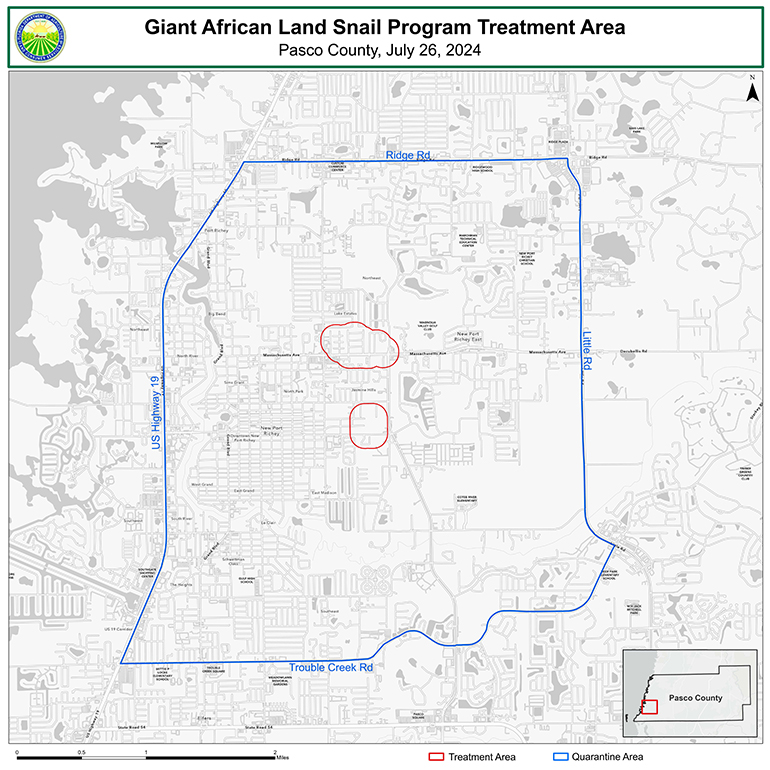
A quarantine is in place starting at the northwest corner of U.S. Highway 19 and Ridge Road. Proceed east on Ridge Road, south on Little Road, west on Trouble Creek Road, north on U.S. Highway 19 (see map).

Treatment
Metaldehyde is a pesticide used to control snails and slugs and is approved for use in a variety of vegetable and ornamental crops in the field or greenhouse, on fruit trees, small-fruit plants, in avocado and citrus orchards, berry plants, banana plants and in limited residential areas. Available products can be applied as granules, sprays, dusts or bait pellets. Applications are typically made to the ground around the plants or crops to be protected.
Property owners inside the treatment area will be notified in person or by posted notice at least 24 hours in advance of the planned pesticide treatment.
Metaldehyde works by disrupting the mucus production ability of snails and slugs. This reduces their digestion and mobility and makes them susceptible to dehydration. Snails and slugs that have eaten metaldehyde often seek hiding places, become inactive and begin to die within days.