Pest Information
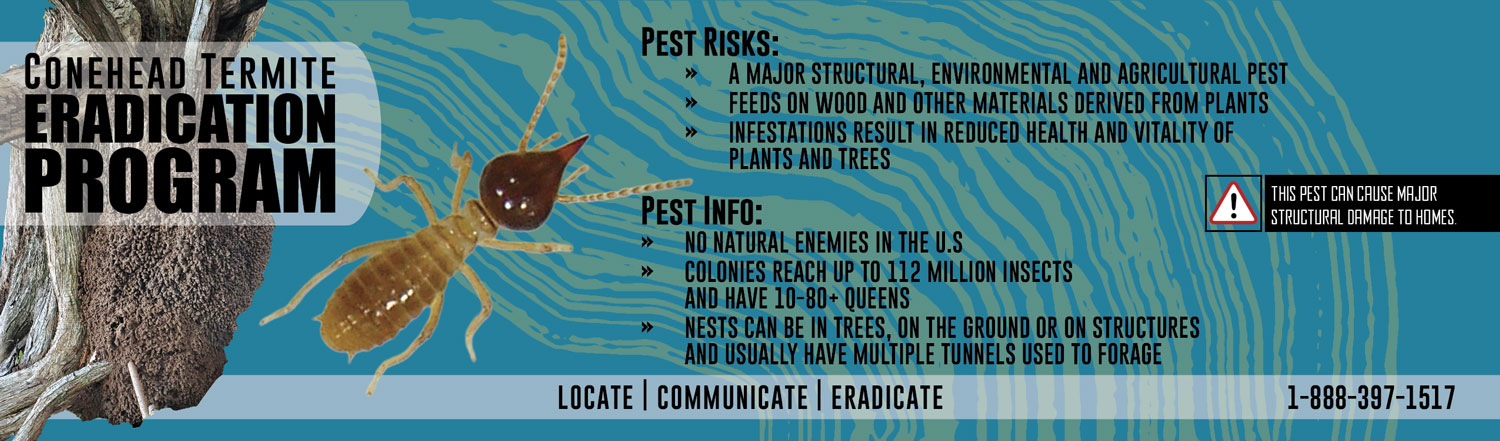
Conehead termite, Nasutitermes corniger, is an arboreal termite that builds nests in trees and makes tunnels to forage. Conehead termite was first detected in Dania Beach, Broward County, Florida in 2001 and is the only detection in the United States. It is suspected the termites were introduced by a boat. A second detection of this pest was discovered in Pompano Beach, Florida in 2016.
This termite could be devastating to the environment and has no natural enemies in the United States. Additionally, it is a structural and agricultural pest. The termite can infest structures and landscapes at a rapid rate causing extensive damage. It consumes wood from dead bark on live or dead trees, shrubs, grasses, roots, wood structures and furniture along with cardboard and other products made of paper.
There are currently two areas in Broward County that require frequent survey and treatment to ensure eradication of conehead termite in Florida. Maps for these survey and treatment areas can be found at the following links:
-
Dania Beach Survey and Treatment Area Map
[
 1.2 MB
]
1.2 MB
]
-
Pompano Beach Survey and Treatment Area Map
[
1.2 MB
]
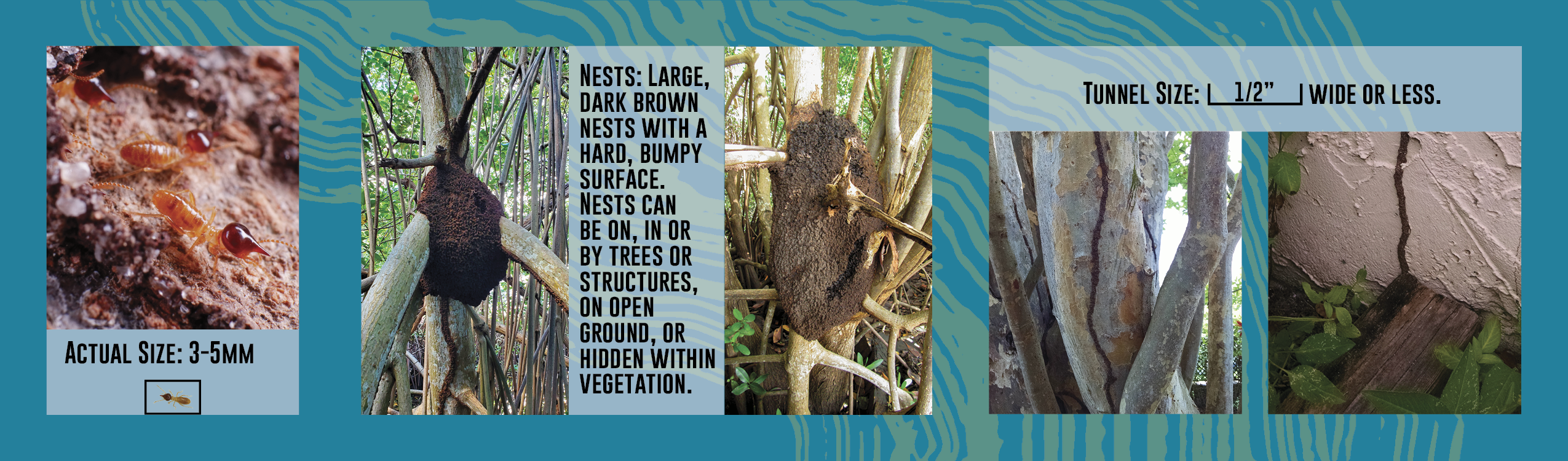
This species of termite travels to their feeding sites in narrow, usually ½ inch wide or less, brown tunnels on the sides of trees, houses or fences.
Soldiers have a cone-shaped, dark brown head from which the termite secretes a pine sap-like chemical to ward off predators, including ants, lizards and termites from another colony. Soldiers are difficult to identify with the naked eye due to their size, but the above-ground tunnels they construct (see below) are easily seen and may signify the presence of this species.
Do you think you have seen conehead termite nests or tunnels? Refer to the ID sheet. Report an infestation by calling the Division of Plant Industry Helpline at 1-888-397-1517 or email a photo to DPIHelpline@FDACS.gov.
-
Conehead Termite ID Guide
[
2.6 MB
]
-
Conehead Termite Pest Alert
[
17.5 MB
]
-
Invasive Conehead Termites: Continued Risk of Introductions and Spread of Destructive Pests
[
1.7 MB
]