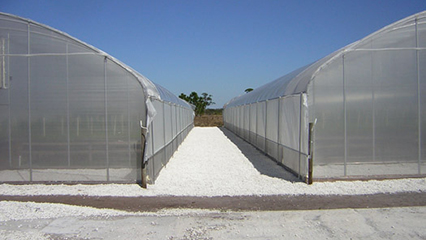
Citrus greening host plants must be produced in an approved structure designed to exclude the Asian citrus psyllid.
Rule Chapter 5B-62, Florida Administrative Code (F.A.C.), prohibits the propagation of all citrus greening host plants, including citrus, orange jasmine, boxthorn and curry-leaf unless the citrus greening host plants are produced in an approved structure designed to exclude the Asian citrus psyllid. The Asian citrus psyllid, Diaphorina citri, is the vector of citrus greening pathogens in Florida.
All propagations of citrus greening host plants, which include all varieties of citrus and all cultivars of orange jasmine, must be produced within a structure and on a site that are both approved by the Florida Department of Agriculture and Consumer Services. All citrus greening host material, including citrus and orange jasmine, not produced in an approved structure is prohibited from movement.
These regulations apply to all citrus propagations and host plants of citrus greening.
List of Affected Plants
The following plants, as listed in Rule Chapter 5B-63, F.A.C., have been determined to be hosts of citrus greening, and the movement and planting of these plants are prohibited unless the plants are produced in compliance with Rule Chapter 5B-62, F.A.C.
- Aeglopsis chevalieri (Chevalier's aeglopsis)
- Balsamocitrus dawei (Uganda powder-flask)
- Calodendrum capensis Thunb. (Cape chestnut)
- X Citrofortunella microcarpa (calamondin)
- X Citroncirus webberi (citrange)
- Citrus spp. (orange, grapefruit, tangerine, etc.)
- Clausena indica (clausena)
- Clausena lansium (wampee, wampi)
- Fortunella spp. (kumquat)
- Limonia acidissima (Indian wood-apple)
- Microcitrus australasica (finger-lime)
- Murraya koenigii (curry-leaf)
- Murraya paniculata (orange-jasmine)
- Poncirus trifoliata (trifoliate orange)
- Severinia buxifolia (Chinese box-orange)
- Swinglea glutinosa (tabog)
- Toddalia lanceolata (toddalia)
- Triphasia trifolia (trifoliate lime-berry)
Requirements
Requirements for citrus nursery structure, orange jasmine, and other hosts of citrus greening listed in Rule Chapter 5B-62, F.A.C.:
- Citrus greening host plants must be grown in insect-proof structures with double entryways that incorporate positive pressure. The structure should be designed so that it cannot be opened at anytime except through the entryway which consists of a double set of doors utilizing positive pressure to force air out the outer door.
- The double entry area must have solid sides and roof so positive pressure is obtained when the first set of doors is opened. Fan(s) and/or an air curtain must be incorporated into the entryway to blow air out the outer doors when they are opened.
- An enclosed vestibule needs to be incorporated into the design to allow for tree delivery and material transfer.
- Insect exclusion screen or non-permeable covering must cover the entire structure with no gaps that would allow insects to enter the structure.
- Screen size must be able to exclude the melon aphid.
- All cooling pads and fans must be covered with insect screen.
- Allowances should be made for ventilation with larger screened areas designed into the ends of the houses to permit air exchange.
- It is recommended that the structures have solid, non-permeable coverings.
- Greenhouse coverings can be poly, fiberglass, polycarbonate, or acrylic panels. When poly is used, a double layer of poly is recommended with a blower fan to inflate the air space between the sheets. Poly must be securely attached to structure, an aluminum poly lock is recommended.
- Other types of corrugated panels must have a closure strip of foam-type material to seal the ends.
- Insect screen is permissible but not recommended as a roofing material due to inherit weakness and tendencies for small holes and tears to occur. It is recommended that appropriate repair materials such as polypropylene tape, silicone caulk and a small amount of extra screening material be kept on hand at all times to make small repairs if the structure is damaged.
- The test for an insect-proof house is that no openings or gaps are visible that would allow insects the size of the melon aphid to enter the structure.
- Smaller gaps between structural members can be sealed with silicon caulk or other suitable materials. The house must also be sealed where the structure meets the ground. It is recommended that the side and gable walls be buried at least six (6) inches into the ground to provide a barrier for insects and or animals.
- It is recommended that nurseries consult with a greenhouse manufacturer or contractor to obtain specific design plans. Ventilation, heating, shading, and windloads are best addressed by the vendors offering the greenhouse components for sale.
All citrus nursery sites established after April 1, 2006, must be approved prior to planting by meeting the following requirements:
- Newly established citrus nursery sites must be a minimum of one mile away from commercial citrus:
- Existing and new citrus nursery sites must be fenced and gated with a controlled entryway
- It is strongly recommended that windbreaks of sufficient height and density be maintained for deterring wind-blown rain:
- Inspection of nursery sites and surrounding areas will occur on a regular basis every 30 days:
- All citrus propagation structures shall be enclosed with a covering to exclude insects. This includes all structures used for budwood sources, nursery trees and seedling production.