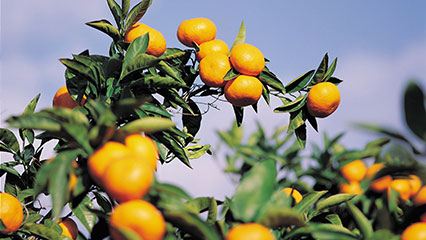
This program provides the Florida citrus industry with new citrus germplasm that is free of any known graft-transmissible citrus pathogens.
The purpose of the Citrus Germplasm Introduction Program is to provide the Florida citrus industry with new citrus germplasm that is free of any known graft-transmissible citrus pathogens.
The Florida citrus industry faces risks including weather, pests, pathogens, rising land prices and international market competition. Examples of these risks include the freezes of the 1980s that essentially destroyed the northern range of the citrus-growing areas in Florida. This event showed the industry's vulnerability to unpredictable weather and identified a need to find new cold hardy varieties of citrus. Discovery of citrus canker and huanglongbing (HLB), or citrus greening, emphasized Florida's vulnerability to exotic diseases and the need to find disease-resistant and disease-tolerant citrus varieties. Discovery of the brown citrus aphid, an effective vector of citrus tristeza virus, and Asian citrus psyllid, vector of HLB, renewed the need to find new resistant rootstocks. Florida's real estate boom decreased citrus production acreage because of the high prices offered to growers. International competition has increased the need to diversify citrus varieties grown in Florida to better satisfy citrus consumers around the world.
Finding new varieties often requires the movement of citrus plants or plant parts (germplasm) across state or international borders. Whenever plants or plant parts are moved from one area to another there is always a risk of moving plant pests and pathogens with it. Once established, exotic pests and pathogens can be devastating. Consequently, new varieties of citrus should be free of pests and pathogens when they are introduced.
There are numerous pests and pathogens of citrus, but graft-transmissible types are the biggest threat. They often show no symptoms on imported plant parts and require special testing techniques. The Citrus Germplasm Introduction Program is responsible for removing any known graft-transmissible pathogens, indexing and testing the new germplasm, and assuring the industry a clean healthy new citrus variety.
Citrus germplasm is prohibited from entering Florida except under permit. The permitting process for domestic and foreign germplasm begins with an Application to Introduce Citrus Plants and Citrus Plant Parts [ Adobe PDF Document ]. Once submitted to the Florida Department of Agriculture and Consumer Services' Division of Plant Industry in Gainesville, Florida, the Citrus Budwood Technical Advisory Committee evaluates the request.
The Citrus Budwood Technical Advisory Committee is composed of eight voting members and five non-voting members. Four of the voting members are owners or employees of citrus nurseries. Four voting members are commercial citrus fruit producers. The non-voting members represent the administrative offices of (1) Florida Division of Agriculture and Consumer Services Division of Plant Industry, (2) The Institute of Food and Agriculture Sciences, University of Florida and (3) the U.S. Horticultural Research Laboratory, USDA Agriculture Research Service, Ft. Pierce.
Upon the recommendation of the Citrus Budwood Technical Advisory Committee and approval from the Director of the Division of Plant Industry, the request is submitted to the new germplasm provider.
All international citrus germplasm (CGIP holds USDA permit #62266, allowing importation of citrus budwood for experimental purposes) must enter the US through the USDA National Plant Germplasm Center in Maryland for inspection. After inspection for pests, the germplasm is forwarded to the CGIP facility in Gainesville.
Interstate sources of new germplasm do not require a USDA import permit and are received directly in CGIP.
Once in Gainesville, each introduction undergoes two types of therapy, shoot-tip micrografting and thermaltherapy, to remove graft-transmissible pathogens followed by a customized program of indexing for known graft-transmissible pathogens of citrus. This process takes several years because the indexing strategy is largely based on biological indexing ─ the budding of the introduction onto pathogen-susceptible citrus varieties and observation for symptoms.
When the testing is complete and the germplasm is negative for known graft-transmissible pathogens, approval is requested to transfer the material to the Bureau of Citrus Budwood Registration. There the new variety will undergo horticultural evaluation, increase and budwood production.