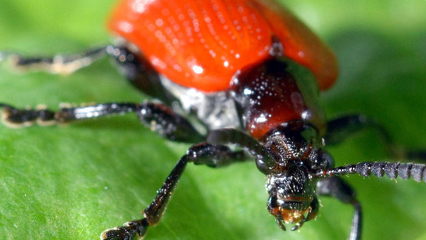
The Beetles Are Back
Air Potato Vine

Air potato leaf
The air potato vine ( Dioscorea bulbifera L., Dioscoreales: Dioscoreaceae) is native to Asia, Africa and northern Australia. It was introduced into the United States in Alabama during the late 1700s and then into southern Florida in the early 1900s. Today, air potato is present in all 67 Florida counties. Additionally, air potato has been reported in Arkansas, Georgia, Hawaii, Louisiana, Mississippi, South Carolina and Texas. The vine grows rapidly, climbing tree canopies and forming dense blankets that smother understory plant species. It can persist in poor soil types and produces large numbers of bulbils, from which new vines sprout. In Central and South Florida, it is considered one of the most common weeds in natural areas.
Most natural and disturbed habitats are susceptible to air potato infestation, including urban lots, floodplain forests, marshes, scrub forest, sinkholes, waterways, and tropical and subtropical hammocks. Air potato is considered one of the most aggressive weeds ever introduced into Florida, and, therefore, it is listed as a noxious weed by the Florida Department of Agriculture and Consumer Services (FDACS) and as a Category I invasive plant by the Florida Exotic Pest Plant Council. Category I invasive plants are defined as "species which are altering native plant communities by displacing native species, changing community structures or ecological functions, or hybridizing with natives."
In Florida, air potato vines sprout in the spring from underground tubers and bulbils that dropped during the previous growing season. Vines cannot support their own weight and will climb vegetation or any structure to reach sunlight. Vines can grow 0.5 to 5 inches (1.5 to 12 cm) per day and more than 65 feet (20 m) during a growing season. If unmanaged, air potato vines cover native vegetation quickly, limiting its access to light. In the fall, when temperatures decrease, the vine will begin to allocate resources for reproduction, generating bulbils and beginning leaf senescence. These bulbils, which can weigh up to 2.2 pounds (1 kg), will drop to the ground, where they will sprout new vines the following season. The underground tubers will also overwinter and produce new vines in spring.
Air Potato Management
Most air potato management methods have proven temporary and ineffective. Chemical control is costly and requires repeat basal and foliar sprays over several years. Damage or death to non-target plants often occurs during these treatments. Additionally, new vines often continue to sprout from underground tubers when herbicide treatments cease. Mechanical control of air potato is labor intensive and time consuming. Temporary removal is possible when vines and bulbils are hand-collected and destroyed. Eradication, however, requires the removal of underground tubers, which can be difficult to access and completely remove.
Biological Control
Biological control was determined to be the most promising management strategy for this invasive plant after the discovery of Lilioceris cheni Gressit & Kimoto (Coleoptera: Chrysomelidae), a beetle that feeds exclusively on air potato leaves. For over 10 years, the air potato biological control program has been a collaborative effort between the FDACS Division of Plant Industry (FDACS-DPI), the U.S. Department of Agriculture's Agricultural Research Service (USDA-ARS) and Animal and Plant Health Inspection Service (USDA-APHIS), and the University of Florida’s Institute of Food and Agricultural Sciences (UF/IFAS).
Release and establishment of L. cheni in Florida have resulted in a massive reduction in vine biomass, bulbil production and spread of the vine. This program is considered one of the major successes in the field of biological control. After several years of research, it has been determined that L. cheni is officially established in Florida and laboratory production and releases are no longer necessary. Therefore, FDACS-DPI is now rearing another federally approved biological control agent that will complement the existing L. cheni populations.
Meet Lilioceris egena (Weise), the New Biological Control Agent of Air Potato
Scientists at the USDA-ARS Invasive Plant Research Laboratory introduced L. egena into quarantine from China and Nepal. Host specificity testing was conducted on 82 plant species belonging to 46 families and 25 orders. Lilioceris egena was found to be highly host specific. A permit to release L. egena in Florida was issued in 2021.
Females of L. egena lay eggs on the underside of and within fallen bulbils. A single female can produce more than 900 eggs during her lifespan. Eggs hatch in approximately 5.5 days. Several larvae can be found feeding voraciously on a single bulbil. The damage is so severe that the interior of the bulbil liquifies, inhibiting its ability to sprout. The larval stage lasts approximately 16 days. After this period, larvae exit the bulbil to pupate in the soil. The pupal stage lasts approximately 12 days. The total developmental time from egg to adult of L. egena is, on average, 35 days. Adults are assumed to live over four months.
Rearing Lilioceris egena
Mass rearing of L. egena occurs under laboratory conditions at 25 ± 1 degrees C and 70 ± 5% relative humidity. Adults of L. egena are released in a mid-size bug dorm with three plastic bins containing sterile dry vermiculite and several bulbils. Each bin contains a damp water wick. Beetles are allowed to feed and lay eggs freely on bulbils. Eggs hatch and newly emerged larvae feed freely on the bulbils.
After approximately 10 days, infested bulbils are split in two groups and moved to bins with sterilized vermiculite to avoid overcrowding. Additional bulbils are added for larvae to feed on. After a month or so, most bulbils appear liquefied and puparia are noticeable in the vermiculite. Liquefied bulbils are split open to check for larvae. If no larvae remain, bulbils are discarded. Adult beetles are collected as they emerge and placed in terrariums with fresh leaves and bulbil slices to keep them alive until use.