Florida Commissioner of Agriculture Wilton Simpson has taken aggressive action and issued emergency rules that place heightened restrictions on the importation of warm-blooded animals into Florida from high-risk areas and USDA- or state-designated infested zones.
Florida Emergency Rule:
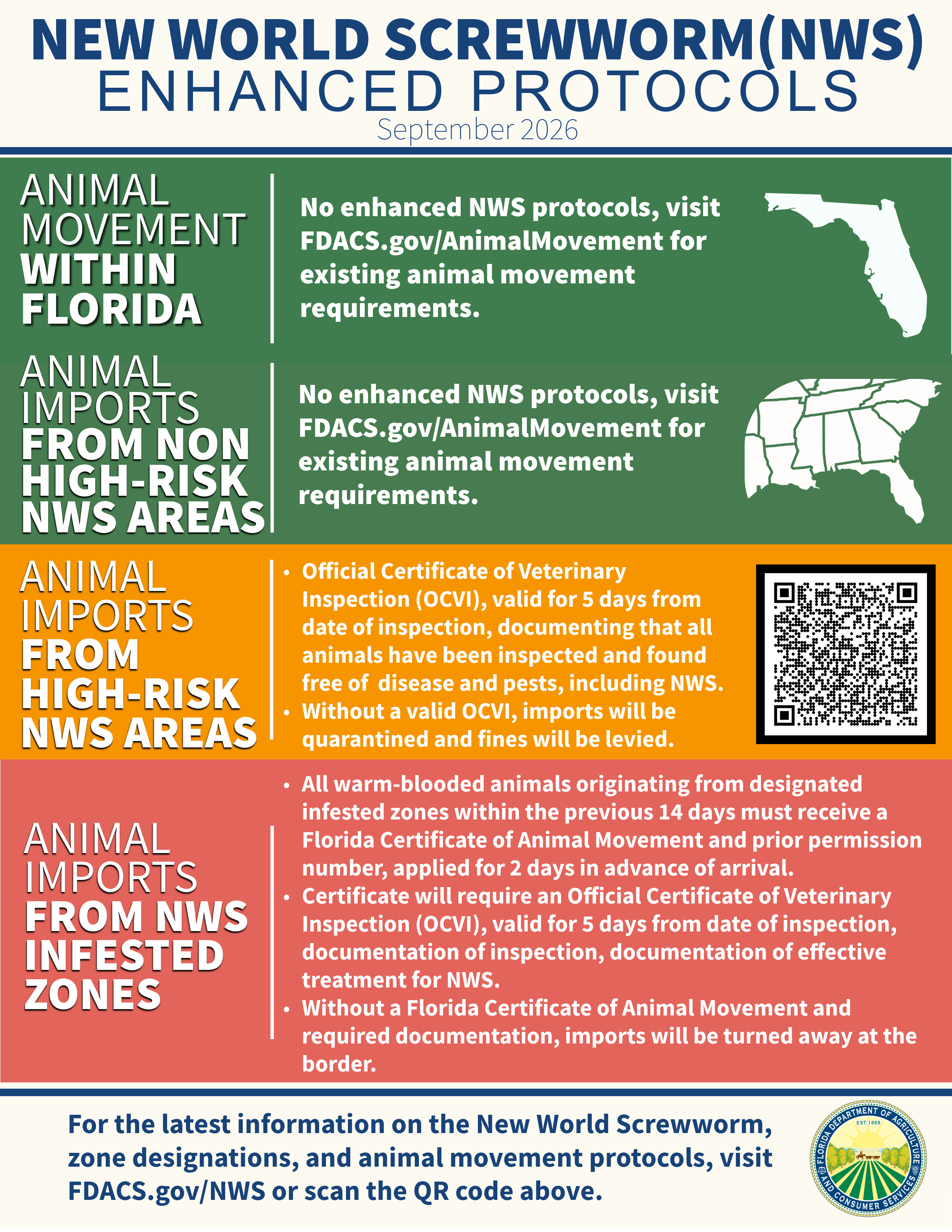
The emergency rule, 5CER26-14, imposes the following temporary restrictions on the importation of warm-blooded animals originating from designated infested zone(s) within the previous 14 days or from high-risk areas:
Infested Zones: Any county where the USDA or the State Animal Health Official has confirmed a breeding population of NWS, as well as adjoining counties.
Infested Zone Counties as of September 4, 2026:
- Texas counties and subsequent surrounding counties: Atascosa, Bandera, Bexar, Brewster, Brooks, Concho, Crane, Crockett, Duval, Edwards, Frio, Hidalgo, Irion, Jeff Davis, Jim Hogg, Kerr, Kimble, Kinney, Maverick, Medina, Menard, Pecos, Presidio, Reagan, Real, Reeves, Schleicher, Starr, Sutton, Terrell, Tom Green, Upton, Uvalde, Val Verde, Ward, Webb, Zapata and Zavala.
- All warm-blooded animals originating from an infested zone being imported into Florida must receive an FDACS Certificate of Animal Movement with prior permission number, applied for two days in advance of arrival. Apply for an FDACS Certificate of Animal Movement.
- The FDACS Certificate of Animal Movement will require the following:
- An Official Certificate of Veterinary Inspection (OCVI), valid for 5 days from the date of inspection, documenting that all animals listed on the OCVI have been inspected and found free of contagious and infectious disease and pests, including NWS. No alternative movement documents will be accepted in lieu of an OCVI.
- OCVI documentation that all animals listed on the OCVI have been treated with an effective treatment for NWS.
- No shelter animals may be imported into Florida from an infested state. Shelter animals include any warm-blooded animals within the custody or care of a public or private animal shelter, humane organization or animal control agency originating from an infested state.
In addition to the requirements above:
High-Risk Areas: Any geographic area which is designated as a High-Risk County or areas of an Infested State outside of the Infested Zone.
- High-Risk County: All U.S. counties within 125 miles of an infested Mexican state.
- Infested State: A U.S. state with one or more infested zones.
High-Risk Areas as of August 31, 2026:
- Arizona counties: Cochise, Gila, Graham, Greenlee, La Paz, Maricopa, Pima, Pinal, Santa Cruz and Yuma.
- California counties: Imperial, Riverside, San Bernardino and San Diego.
- New Mexico: Catron, Chaves, Dona Ana, Eddy, Grant, Hidalgo, Lincoln, Luna, Otero, Sierra and Socorro.
- Texas: All counties that are not listed as an Infested County.
- All warm-blooded animals originating from a high-risk area being imported into Florida must be accompanied by an Official Certificate of Veterinary Inspection (OCVI), valid for 5 days from the date of inspection, documenting that all animals listed on the OCVI have been inspected and found free of contagious and infectious disease and pests, including NWS. No alternative movement documents will be accepted in lieu of an OCVI.
- The OCVI must include the statement, “All animals listed on the OCVI have been inspected and are free from screwworm larvae infestation.”
- The OCVI is valid for no more than 5 days from the date of veterinary inspection.
New World screwworms are fly larvae (maggots) that can infest livestock and other warm-blooded animals, including people. They most often enter an animal through an open wound. They feed on the animal’s living flesh and, if not treated, infestations can be fatal. While New World screwworm (Cochliomyia hominivorax) has not been widely present in the United States since the 1960s, it is still found in most of South America and in five Caribbean countries. Cases began spreading in 2023, through Mexico, with the reintroduction into the United States in June 2026 within Texas and New Mexico.
See locations of recent confirmed cases of New World Screwworm Outbreak.
Signs
Screwworms are typically found on warm-blooded animals that have a draining or enlarging wound.
Screwworm eggs are creamy and white and deposited in a shingle-like manner on or near the edges of superficial wounds. The larvae are cylindrical with one pointed end and one blunt end and have rings of dark brown spines around the body. Female screwworm flies are larger than a housefly with a dark blue to blue-green body and reddish-orange head.
Almost any type of wound can become infested with screwworm larvae, including those caused by feeding ticks, castration, dehorning, branding, shearing, barbed wire fences, and even shedding of antler velvet in deer. The navels of newborn mammals can also become infested.
It can be very difficult to see the early stages of screwworm larvae feeding in a wound. The most obvious sign is a change in the wound’s appearance — as larvae feed, the wound gradually enlarges and deepens. An infested wound also gives off an odor and some bloody discharge.
Even if the actual wound on the skin is small, it could have extensive pockets of screwworm larvae beneath it. Infested livestock usually show signs of discomfort, and they may go off their feed and produce less milk. Typically, these animals will separate themselves from the rest of the flock or herd and seek shady or secluded areas to lie down. Infested animals that are not treated in seven to 14 days may die. Signs of screwworm infestation in animals include:
- Wounds in living animals infested with maggots
- Blood-tinged discharge from the infested wounds
- Foul odor
- Discomfort
- Depressed/no eating
- Decreased milk production
- Seclusion from rest of herd or flock
Guidance for Human Health
While the occurrence of screwworms in humans is less common than in livestock or other mammals, people are urged to keep wounds clean and closely monitor open cuts and wounds for the presence of maggots. Anyone who suspects the presence of screwworms should contact a physician immediately.
While human cases of New World screwworm are rare, they have occurred. People infested with screwworm usually have discomfort or itching at the wound site.
Guidance for Animal Health
Carefully inspect animal wounds and hides for signs of screwworm. Owners should immediately consult their veterinarian if a case of screwworm is suspected.
Treatment
If you suspect a New World screwworm infestation, contact your veterinarian immediately. Screwworm infestation is treated by cleaning the site and topical application of a pesticide or other medication effective at killing the screwworm larvae. Treated wounds should be inspected daily until completely healed. The examining veterinarian will remove larvae from the wound with tweezers, place them in alcohol, and report to the Florida Department of Agriculture and Consumer Services' Division of Animal Industry (State Veterinarian’s Office).
-
NWS Treatment/Prevention for Companion Animals (Dogs and Cats) and Wildlife
[
 174.4 kB
]
174.4 kB
]
-
NWS Prevention/Treatment for Equine
[
212.6 kB
]
-
NWS Prevention/Treatment for Livestock
[
238.3 kB
]
Products for NWS Control in Animals
- FDA-Conditionally Approved and Authorized Animal Drug Options
- Florida 2ee Bulletins for Insecticide Products:
-
Clean Up II
[
138.3 kB
]
-
Co-Ral Fly and Tick Spray
[
141 kB
]
-
Cylence Pour-On Insecticide
[
146 kB
]
-
Cylence Ultra Pest Control Concentrate
[
145.8 kB
]
-
Cylence Ultra Premise Spray
[
137.1 kB
]
-
Elector
[
134.3 kB
]
-
Permectrin CDS Pour-On Insecticide
[
141.7 kB
]
-
Permectrin Dust
[
140.1 kB
]
-
Permectrin II
[
158.5 kB
]
-
Prozap Insectrin X Concentrate
[
259.1 kB
]
-
Prozap Screwworm Ear Tick Aerosol
[
232.7 kB
]
-
Vapona
[
158 kB
]
-
Clean Up II
[
- USAHA: New World Screwworm Products
- USDA APHIS: Pesticides for Control of New World Screwworm [ Adobe PDF Document ]
Report Suspected Cases
Anyone who suspects the presence of screwworms or has questions or concerns can contact:
- By phone during office hours: (850) 410-0900
- By phone after hours: 1-800-342-5869
- Via email: RAD@FDACS.gov
- Report online at: www.FDACS.gov/RAD
Wildlife Reports
To report sick or injured wildlife, including a suspected screwworm infestation, call the Florida Fish and Wildlife Conservation Commission (FWC) at 1-888-404-FWCC (3922) or email the Wildlife Health Team at WildlifeHealthTeam@MyFWC.com.
History
In the 1950s, the U.S. Department of Agriculture's (USDA) Agricultural Research Service developed a new method to eradicate the pest using a form of biological control called the sterile insect technique. Infertile male flies are released in infested areas. When they mate with local females, no offspring result. With fewer fertile mates available in each succeeding generation, the fly breeds itself out of existence.
USDA began using this technique in Florida in 1957 and eradicated the flies from the entire southeastern United States by 1959. The technique was next applied to the more extensively infested Southwest in 1962. By 1966, self-sustaining screwworm populations were eliminated from the United States. However, there were still infestations in Mexico, and animals crossing the border were causing some reinfestations in the United States. USDA worked with Mexican officials to reduce the flies in that country. After 1982, there were no more reinfestations in the United States, and Mexico was officially declared free of screwworms in 1991. USDA then partnered with the countries of Central America to eradicate New World screwworms, and until the current outbreak, a permanent sterile fly barrier at the Darien Gap between Panama and Colombia prevented the flies from moving back into Central America.
The last outbreak in the U.S. occurred in September 2016, when the presence of New World screwworm was confirmed in Key deer from a wildlife refuge on Big Pine Key in Monroe County, Florida.
The Florida Department of Agriculture and Consumer Services worked closely with the USDA and other partners on control and response efforts to eradicate the screwworm by early 2017.
Resources
- Information on the Screwworm Eradication Program (USDA APHIS)
- New World Screwworm in Wildlife (FWC)
- New World Screwworm Outbreak in Central America and Mexico (USDA APHIS)
- New World Screwworm with FDACS (Spotify): Dr. Diane Kitchen, August 7, 2025
- New World Screwworm with FDACS (YouTube): Dr. Diane Kitchen, August 7, 2025
- The Return of Screwworm: Threats, History and What Comes Next (Spotify): Dr. Andrew Short and Dr. Ted Burgess, July 18, 2025
- UF/IFAS: New World Screwworm
Screwworm Information Sheets
- Screwworm Brochure (English Version) [ Adobe PDF Document ] (USDA APHIS)
- Screwworm Brochure (Spanish Version) [ Adobe PDF Document ] (USDA APHIS)
- Screwworm Factsheet [ Adobe PDF Document ] (USDA APHIS)
- Screwworm Pest Alert (English Version) [ Adobe PDF Document ] (USDA APHIS)
- Screwworm Pest Alert (Spanish Version) [ Adobe PDF Document ] (USDA APHIS)
- Screwworm Poster [ Adobe PDF Document ] (USDA APHIS)