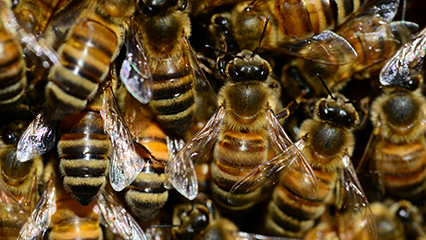
Managed honey bee colonies are an important part of Florida agriculture. They produce unique varieties of Florida honey, pollinate many plants that produce fruits, vegetables and nuts, and support the livelihood of Florida beekeepers.
Unfortunately, feral honey bees can become a nuisance when they take up residence in cavities near places people frequent, such as soffits and walls of homes/buildings, lawn debris, water meter boxes, trees, etc. Nuisance colonies become problematic when they pose a stinging threat to nearby humans and animals.
Unwanted honey bees can be removed alive and repurposed as a managed colony under Rule 5E-14.151, Florida Administrative Code (F.A.C.), or they can be eradicated from the location by a certified pest control operator.
Homeowners can take steps to prevent honey bee swarms from establishing nests in unwanted areas of the home by “bee-proofing.”
Honey Bee Swarm or Colony?
Part of the reproductive life cycle of the honey bee is called swarming, an event in which a new colony is produced from an existing colony.
Swarm
Colony
Live Honey Bee Removal or Eradication?
Live Honey Bee Removal
In some cases, depending on the size, location and temperament of an established colony, a registered Florida beekeeper can remove an established colony and all of its components (bees, comb, brood, honey) and relocate them safely to an apiary. Swarms, given their transient state and docile nature, usually can be removed easily and relocated to an apiary. Beekeepers hired to conduct live removal of honey bees are required to be registered with the Florida Department of Agriculture and Consumer Services (FDACS) but need not be licensed under Chapter 482, Florida Statutes (F.S).
Registered beekeepers can remove and relocate nuisance swarms or established colonies in accordance with Rule 5E-14.151, F.A.C., and can request to be on the Bee Removal or Eradication List. Beekeepers should use Best Management Practices for Live Bee Removals in Florida: A Beekeeper’s Guide [ Adobe PDF Document ] as a reference for performing live bee removal services in Florida.
Eradication
In most cases, the eradication of bees is regulated under the Structural Pest Control Act, Chapter 482, F.S. Only a licensed pest control company can provide the service of eradication of a colony (Section 482.021, F.S.). Eradication is often the safest and preferred choice when the colony is nesting in a location that poses a stinging threat to humans, does not facilitate safe removal (e.g., high up in a tree, deep in an occupied dwelling, near a school, etc.), or is deemed no longer able to thrive.
It is important to note that it is the property owner’s choice concerning how a colony is removed. Although honey bees are an important agricultural resource, it is NOT illegal for a licensed pest control company to eradicate a nuisance honey bee colony. In some cases, public safety necessitates that a given colony be eradicated.
It is recommended that without the proper equipment and training you should never attempt to remove or eradicate a nuisance honey bee colony yourself. It can be dangerous and, if not done properly, can lead to a violation of state or federal pesticide laws and liability if someone is hurt in the surrounding area.
Honey Bee Removal or Eradication List
FDACS maintains a list of Registered Beekeepers and Certified Pest Control Operators who perform bee removal and/or eradication services. FDACS provides this list for reference purposes only. No endorsement or recommendation is implied.
Honey Bee Removal or Eradication List
[
 70.7 kB
]
70.7 kB
]
Registered beekeepers or pest control operators who perform bee removal or eradication services and would like to be included on the list should complete and submit a Request for Inclusion on Bee Removal or Eradication List.
Tips for the Consumer
When a company or person is hired to remove or eradicate a colony on your property, FDACS suggests the following:
- Ask for their beekeeper registration number or pest control license number (this is required in order to perform eradication or removal in the state of Florida).
- Ask if the beekeeper or pest control operator carries liability insurance.
- Ask about previous experience in conducting this type of service.
- Ask about their plan to remove existing comb and honey that could attract nearby bees.
- Ask about the method of removal or eradication they will be using and where the bees are being relocated.
- If there is structural damage, ask if there is a plan to repair damages or if a third-party contractor needs to be hired.
- If a tree needs to be removed or cut, ask if there is a plan to remove any remaining parts or debris from your property.
- After colony removal or eradication, be sure to check for further bee activity at the site and follow up with the company/person hired, if needed.
- Be sure to follow bee-proofing recommendations to prevent honey bees in unwanted locations.
- Note: Genetic testing is required to determine if honey bees are African or European. It is impossible to tell the difference with the naked eye. Be sure to always take caution around any honey bees.