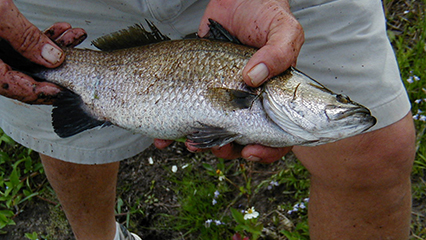
Food-fish producers culture both saltwater and freshwater species as food.
In 2023, sales of food fish in Florida totaled $26.25 million and included tilapia, catfish, sturgeon, striped bass, cobia, pompano and red drum.
Licenses and Permits
If you are interested in commercially culturing food fish in Florida, you must apply for an Aquaculture Certificate of Registration and comply with
Aquaculture Best Management Practices
[
 960.9 kB
]
.
960.9 kB
]
.
The processing or selling of aquatic products as a food product may require a Food Permit from the Florida Department of Agriculture and Consumer Services (FDACS).
Restricted Species
Food-fish producers culture a wide variety of species, including some restricted species. Restricted species are nonnative species that require special authorization from FDACS or the Florida Fish and Wildlife Conservation Commission (FWC) if you wish to produce them commercially or possess them for research or public exhibition.
Restricted species are not authorized for personal use.
Commercial production of restricted species requires:
- An Aquaculture Certificate of Registration,
- Compliance with
Aquaculture Best Management Practices
[
960.9 kB
]
(BMPs) and
- A Restricted Species Authorization letter from FDACS. (Email Serina.Rocco@FDACS.gov for more information.)
Tilapia
Blue tilapia (Oreochromis aureus), Nile tilapia (O. niloticus) and hybrids of the two species may be possessed, transported and cultured without a special permit in four FWC-designated regions: North Central, Northeast, South and Southwest. See Rule 68-5.002, Florida Administrative Code. However, aquaculture of these species is restricted in the Northwest region. If your farm is located in this area, a Restricted Species Authorization is still required.
Per the Aquaculture Best Management Practices, aquaculture of a restricted species requires a Aquaculture Certificate of Registration and a Restricted Species Authorization letter. Check with FWC Exotic Species Coordination staff at (850) 488-3831 to determine which species you possess.
If you have questions about tilapia permitting requirements, contact Serina Rocco at (850) 617-7600 or Aquaculture_Certificate@FDACS.gov.
Nile Perches (Lates)
Fish of the genus Lates, including barramundi (Lates calcarifer), are restricted species throughout Florida. Before you obtain any barramundi, you must provide FDACS with a detailed facility plan, including hurricane-rated buildings, and a construction timeline. The culture of any fish in the genus Lates is limited to indoor facilities.
Florida Bass
In 2021, Chapter 597.004, Florida Statutes, was amended for the culture of Florida bass (Micropterus salmoides) for human consumption. Protecting the genetic integrity of Florida bass, Florida’s State Freshwater Fish, is critical to ensure the long-term viability of this important and iconic Florida game fish. Visit FWC's Florida Bass webpage for more information.
Refer to the
Florida Bass Aquaculture: Rules and Regulations
[
838.5 kB
]
for regulatory guidance.
The largemouth bass (Micropterus nigricans) is a restricted species throughout Florida. Intergrade largemouth bass (northern largemouth bass x Florida largemouth bass (Micropterus salmoides nigricans) is a restricted species that may only be possessed in the Suwannee River and its tributaries and north and west of the Suwannee River.
Additional BMPs
Producers of restricted species must meet additional BMPs, including more stringent requirements for containment, sales and records. BMPs for restricted species include the following:
- Restricted species cultured outdoors (when permissible) must be held in a water body that has the lowest point of the top edge of its levee, dike, bank or tank at least 1 foot above the 100-year flood elevation issued by the Federal Emergency Management Agency.
- There must be effective measures to prevent theft of restricted species.
- All holding, transport and culture systems must consist of a solid construction and be designed to prevent escape of all life stages of the restricted species and deter predator access.
- Restricted species may be taken on a fee or for-hire basis using hook and line or rod and reel as long as anglers are accompanied by the facility operator or employee and no live animals leave the facility with persons that do not possess a Restricted Species Authorization or Conditional Species Authorization for the particular species.
- Nile perches (Genus Lates, all species including barramundi) shall not be taken on a fee or for-hire basis using hook and line or rod and reel.
- Live sale or transfer of restricted species and their hybrids is limited to those authorized by FDACS or FWC.
- All records of live restricted species purchases, sales and transfers must be maintained and available for inspection for a period of at least two years.
Aquaponics
Tilapia is commonly included in commercial aquaponics systems. Aquaponics is an aquaculture system in which wastes produced by farmed aquatic animals supply nutrients for hydroponically grown plants, which in turn purify the water.
Additional information regarding aquaponic systems is available in our
Commercial Aquaponics: Rules and Regulations (English)
[
502.7 kB
]
or
Commercial Aquaponics: Rules and Regulations (Spanish)
[
795.8 kB
]
FDACS regulates commercial vegetable production. If you plan to produce herbs, leafy greens or other vegetables aquaponically, these regulations may apply to you.
Technical Assistance
For aquaponic production information, visit Florida Sea Grant's Aquaponics: Growing Fish and Food website.