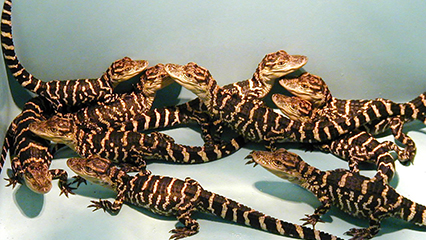
Alligators
Alligator farmers take captive-bred or wild-collected alligator eggs and hatchlings and grow them out in optimal conditions. In about two years the alligators attain a marketable size (approximately 4 feet in length) and can be harvested for their meat and hides.
Licenses and Permits
If you are interested in farming alligators in Florida, you must apply for an Aquaculture Certificate of Registration and comply with
Aquaculture Best Management Practices
[
 960.9 kB
]
(BMPs). The Florida Department of Agriculture and Consumer Services (FDACS) reviews all aquaculture activities to ensure compliance with the BMPs.
960.9 kB
]
(BMPs). The Florida Department of Agriculture and Consumer Services (FDACS) reviews all aquaculture activities to ensure compliance with the BMPs.
In addition, you must obtain an Alligator Farming License from the Florida Fish and Wildlife Conservation Commission (FWC).
Farmers who want to display alligators to the public in addition to raising them must obtain a License to Possess Class II Wildlife for Exhibition or Public Sale from FWC. The possession and display of Class II Wildlife require facilities to follow more advanced animal housing and containment measures for the safety of the wildlife and the public.
Freshwater Turtles
Freshwater turtles are cultured in Florida for the pet trade and food markets and are sold domestically and internationally. If selling turtles for food, the producer typically sells the hatchlings overseas for further grow-out. Ornamental producers strive to produce very unique individuals with various aesthetic attributes for hobbyists to enjoy.
Licenses and Permits
If you are interested in starting a farm in Florida for commercial production and sale of aquatic turtles, you must apply for an Aquaculture Certificate of Registration and comply with
BMPs
[
960.9 kB
]
.
In 2008, FWC prohibited the harvest of wild, native turtles for commercial use. Additional conservation measures have been enacted by FWC for freshwater turtles. Aquaculture producers must purchase broodstock from a certified aquaculture facility producing turtles or from an out-of-state source and retain all paperwork for purchases. Proof of origin should indicate the species, number of specimens, seller and buyer.
Licensed aquaculture producers in Florida must include their Aquaculture Certificate of Registration number on all sale or transfer-of-ownership documents (receipts, bills of lading, invoices, etc.). Producers are encouraged to include their Aquaculture Certificate of Registration number on product packaging as well.
Restricted Species
Not all turtles cultured in Florida are indigenous to the state. Many of the species raised for the pet trade are from exotic locations around the world. Commercial facilities must be designed to prevent the escape of aquaculture broodstock and products. The red-eared slider (Trachemys elegans), a nonnative turtle that has been popular in the pet trade, is a restricted species in Florida. Pastel and albino color variants of the red-eared slider are not restricted species.
Aquaculturists wishing to culture a restricted species must meet additional containment criteria and be issued a Restricted Species Authorization from FDACS, specific to that species. The Restricted Species Authorization does not require a separate application. Instead, FDACS staff will review the species you selected on your Aquaculture Certificate of Registration application and evaluate your need for this authorization. To qualify for a Restricted Species Authorization, you must meet the Best Management Practices for each species listed as restricted. For more information on Restricted Species Authorization, call (850) 617-7600 or email Serina.Rocco@FDACS.gov.
Amphibians
Amphibians are primarily cultured in Florida for the pet trade, and some, like axolotls, are also cultured in Florida for research.
Licenses and Permits
If you are interested in starting a farm in Florida for commercial production and sale of amphibians, you must apply for an Aquaculture Certificate of Registration and comply with
BMPs
[
960.9 kB
]
. FDACS reviews all aquaculture activities to ensure compliance with the BMPs.